 Wind in the SAIL project – partners met in the spring 2018 to discuss and develop ideas that will create new possibilities within the project. The result was a new calculation tool, that will make sail cargo transport more accessible.
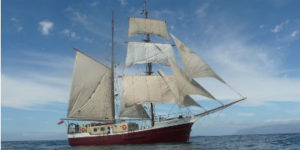
Routes by sail are often long and takes more time than direct transport by lorry or plane, so even though transport by sail has close to zero emissions, it is not very competitive. However, a meeting set at the Port of Oostende in Belgium, between partners of DUAL Ports and the Sail Cargo Alliance may have taken new steps to realise the Sail Cargo Network – a DUAL Ports pilot that will facilitate cooperation between cargo owners, ship owners and ports.
Finding the edge
Transport by sail is dependent on wind, which makes routes in the North Sea and the Baltic Sea optimal for sail cargo, due to the short distances and preferable wind conditions. A sailing ship will be able to carry the load equivalent to two lorries and will under these conditions become very competitive.
Therefore, a calculation tool has been developed, that will make it possible for cargo owners and ship owners to calculate the cost for transport. The tool takes different factors into consideration – i.e. weather conditions, passengers, tons of cargo, the price for pilotage and other costs. This will help ship owners to present and negotiate a transparent price to the cargo owners.
During the course of the workshop, this tool was implemented in an online version, that will in the end be able to make it possible for cargo owners and ship owners to find each other and negotiate a price from the calculation.
The first edition will be shown as part of an artistic exhibition at Time’s Up in Malta – a futuristic exhibition, showing how people will likely interact in the future.
“This will give an idea of how the tool will look. We will develop the backend, and in the end, this tool will be able to show where a certain ship is, how much cargo it carries and when it will reach its destination, counting in routes and weather conditions. Cargo owners will then be able to calculate approximate prices and contact the ship owner”, says Madadh MacLaine, founder and CEO of the Fair Winds Trust.
In order to develop and launch the tool, Madadh MacLaine hopes for an extension of the DUAL Ports project, in order to have a test run for two years. If successful, this tool will become a legacy of the project, that will
 The workshop was followed by a joint dinner, hosted by the Sail Cargo Alliance, where products already being shipped by sail were presented. The guests had the opportunity to taste different wines, rum, coffee and olive oils shipped by sail from Porto, Portugal.
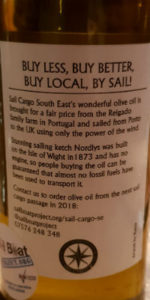 The Sail Cargo Network is thought as a natural choice for manufacturers and consumers, who wish to use a sustainable supply chain from production to end consumer.
The Sail Cargo Alliance
The Sail Cargo Alliance is a group of shipowners and cargo owners that join together to promote and enhance transport by sail.
“An alliance of organisations who share a passion for sail-shipped cargo, working together with shared ethics to create a healthy transport culture that promotes the preservation of the environment for future generations.” – www.sailcargoalliance.org‘
The DUAL Ports project
DUAL Ports is an Interreg North Sea Region project, 50% co-funded by the European Regional Developmental Fund. DUAL Ports consists of 8 different pilot projects that all aim to develop methods and technologies that will make regional entrepreneurial ports more sustainable, and more competitive – www.dualports.eu
The Fair Winds Trust
The Fair Winds Trust is pilot leader of the SAIL pilot in DUAL Ports. The SAIL pilot aims to create a Sail Cargo Network that will connect ship owners, cargo owners and ports, to facilitate the opportunities for sail cargo transport – www.dualports.eu/sail and www.fairwindstradingcompany.org
 The scene was set in June at the northern isles of Scotland – The Orkney Islands. The agenda was the progress of the DUAL Ports Hydrogen Pilot.
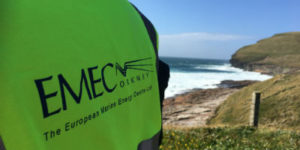
Winds were raising, but the sun was high, when the DUAL Ports partnership met in Kirkwall, Orkney, to explore the possibilities of wave, tide and wind energy, and the production and bunkering of hydrogen for ferry vessels. The partnership was welcomed in Scapa, Orkney, by Technical Superintendent David Hibbert, who gave an introduction to the islands and the Orkney Islands Council Marine Services.
The initial point of the Hydrogen pilot, within DUAL Ports, was to develop a business case, where hydrogen for use in cars and shore site operations would be applied to a bunkering system for moving vessels. A hydrogen ferry was a hypothetic idea, at the beginning of the project.
 However, Orkney Islands Council are working on different hydrogen projects, and as things develop a hydrogen ferry is now planned to be developed through another project (HySeas III), to be launched in 2020. Therefore, a bunkering system for this vessel has now become a reality and the Hydrogen pilot in DUAL Ports is no longer ‘just a paper project’. ITM Power will be working with Orkney Islands Council Marine Services to assess a number of bunkering options, as well as providing green hydrogen to the ferry, that will result in a ground breaking development for marine transport.
“Within two years’ time, we will have the need for an actual bunkering system, for this new hydrogen vessel. The HySeas III project will develop the world’s first renewables-powered hydrogen ferry, marking a paradigm shift towards entirely emissions-free marine transport,” says David Hibbert, Technical Superintendent of Development and Infrastructure, Orkney Islands Council Marine Services.
Why Hydrogen?
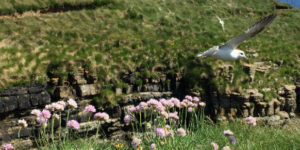 Orkney is an island group north of Scotland, that consists of 70 different islands. The position of the islands make for perfect weather conditions and the islands are self-sufficient in renewable energy due to massive tides going in and out of the North Sea, and preferable wind conditions. In fact, the islands produce more energy than can be consumed, and even more than can be exported to the mainland and the national electricity grid – therefore, efforts are being made investigating and researching how to use the excess amounts of renewable energy on the islands, in order not to waste it.
DUAL Ports will be presented at a Trade Mission on May 31, 2018.
A delegation of British businesses including also the British Ambassador in Denmark, Mr. Dominic Schroeder, will visit the Port of Vordingborg, along with four other Danish ports.
Their interest is in port development and infrastructure, and they will have a tour of the port, exploring the ongoing expansion of the port. This will be presented along with the general DUAL Ports project, and other developmental projects in the region of Vordingborg, Denmark.
DUAL Ports will be presented at an international trade mission, where a British delegation of companies will visit the Port of Vordingborg and learn more about the development and infrastructure of the port.
The delegation will visit five different Danish ports, and the Port of Vordingborg has a full day programme on the 31st of May, where the British Ambassador Mr. Dominic Schroeder also will attend.
The project DUAL Ports will be presented by one of the partners, CEO of Business Vordingborg Susanne Kruse Sørensen. The SOIL pilot will be presented by lead partner Development Manager Jan-Jaap Cramer.
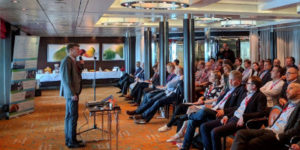 In order to gain a broader network for the upcoming work on LNG, the Dual Ports were present at the 48 hours conference GoLNG Tour on board the Norwegian LNG ferry “Stavangerfjord”.
The conference featured nearly 100 participants from companies and businesses from the LNG Cluster in North Sea and the Baltic Sea. All the participants were there to demonstrate their vast knowledge, cutting edge technologies and newest innovations to the world.
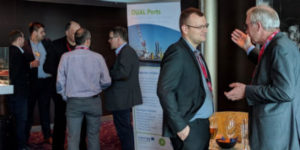 Dual Ports hosted a reception on the conference second day and garnered huge attention. New connections were made and potential pilots to the DUAL Ports from stakeholders in Denmark, Norway and Germany were discussed.
In Denmark the news of the Port of Skagen commitment to LNG sparked the interest of the fishers’ present who are currently looking into LNG options for their upcoming new builds. In addition, Danish ship architects and ship builders also voiced their interest for the DUAL Ports project following the news of the Port of Skagen’s commitment to the project.
Potential investors for the LNG operations in Denmark were also uncovered through conversations with the Danish representatives present at the conference. The two trusts Inseroand Skagen Trustwhere pointed to as potential investors for the project.
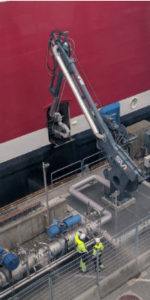 In Norway the company Liquiline expressed a keen interest in providing the LNG solutions for both the Port of Skagen and the Port of Zwolle in order to expand the currently limited LNG Supply network in the SECA area.
In Germany the port of Rostock expressed an interest in joining the Dual Ports project, but also added that in addition to the goals set by DUAL Ports, they would also focus on how to reduce the noise levels in the port as this is a major environmental concern for the port administration.
In total the conference resulted in 29 new connections from various parts of the LNG supply chain, all of whom are interested and willing to help the DUAL Ports project in any way they can.
DUAL Ports will be presented to partners in Interreg Baltic Sea Region, at a matchmaking event sailing between Norway and Denmark.
The Go LNG project & the BALTIC SEA REGION LNG CLUSTER has invited different partners to a “hands-on” International Conference, Study Trip and Matchmaking Event.
The event will be a 48 hour conference onboard Fjord Line’s LNG powered ferry, M/S Stavangerfjord, going from Bergen (Norway) via Hirtshals (Denmark) and Langesund, Oslo (Norway) and back again, while participants can experience and learn more about:
- The latest news on LNG development and technologies
- TTS LNG bunkering
- Guided tour at M/S Stavangerfjord “LNG from the Engine room to the Bridge”
- Matchmaking meetings with leading market players
- Outstanding networking opportunities
DUAL Ports will also board the ship, and you can see the full programme here.
On the 19th of March our partner Madadh MacLaine of Fair Winds Trust will be presenting DUAL Ports and the Sail Cargo Network at an event in Copenhagen, Denmark.
IWSA member, Captain Geoff Bourne is currently engaged in refitting his sail cargo vessel, the SV Lo Entropy in Hundestad, Denmark with the intention of operating her in the Baltic later this year onwards – carrying 36 tons of cargo and up to 8 passengers.
At this Copenhagen event Geoff, a veteran sail cargo captain in the Caribbean and East Africa, will introduce the vessel and his company plans.
You will also have a chance to hear from Gavin Alwright, Secretary of the International Windship Association.
The event will be held at City Hotel Nabo, Copenhagen V, 50 meters from the west side entrance/exit of Copenhagen Central Station.
You can read more about Captain Geoff Bourne’s vessel, SV Lo Entropy on their website.
The Sail Cargo Alliance will meet in the Port of Oostende from April 13th-15th.
SCA members, cargo owners and DUAL Ports partners will meet and work on the Sail Cargo pilot, and the possibility of having a sail cargo hub at the Port of Oostende.
You can read more about the meeting via this Facebook-event.
If you wish to participate in this event, please RSVP via this link.
NEW MEMBERS: If you are joining the SCA for the first time please take a moment to fill out this questionnaire, so that they have all your details.
You can read more about the Sail pilot here.
 On January 19, the Ports Energy and Carbon Savings (PECS) held an opening conference in Southampton, England. PECS is an international cooperation project in the Interreg 2Seas Programme.
Similar to DUAL Ports, the PECS project focuses on the reduction of carbon in ports and marinas, while also considering cost efficiency.
Our lead partner, the Port of Oostende, is lead partner of PECS, and participated in the opening conference. The DUAL Ports project was presented at the conference, focusing on the example of low carbon ports in the North Sea and the cost-benefit tool developed by HWWI.
The similarity of the two projects opens up further possibilities for transnational cooperation and knowledge sharing between the partners.
About PECS
The overall objective of the PECS project is developing, testing and validating various methods, tools and concepts and realising and demonstrating proven and innovative applications for energy efficiency, specific coast-related renewable energy sources and energy storage in such a way that small and medium-sized ports will adopt and use these technologies much more, will start-up energy-cooperations with all local stakeholders (in and outside ports) and are able to reduce their carbon emissions significantly.
Interreg 2 Seas is a European Territorial Cooperation Programme covering England, France, the Netherlands and Belgium (Flanders).
The Programme is part-financed by the European Regional Development Fund and has a total of €241m ERDF to co-finance projects in the 2014 – 2020 period.
Read more about PECS at their website, www.pecs2seas.eu
The Partners of DUAL Ports are happy to announce, that the Port of Skagen has been accepted as a new partner in the project. The Port of Skagen will become the lead partner of the LNG pilot, exploring the possibility to install a bunkering system for LNG at the port.
“Port of Skagen is excited to become part of the DUAL Ports Program. We look forward to investigate how we can contribute to a reduced carbon footprint, and to analyse on future possibilities for developing LNG options in the port, says CEO Willy B. Hansen”
The Port of Skagen is a sea port in the northern part of Denmark, and is the largest landing port in Europe for pelagic fish. Fishery has for many generations been one of the biggest industries in the area. The Port also has a strong maritime network, that performs service and construction for maritime vessels, both at the port and offshore. The position at the top of Denmark also makes Port of Skagen an ideal location for cruise ships.
The Port of Skagen has ambitious plans for growth in the future, and for the past ten years, the port has expanded the port and quay areas in three phases – the latest still ongoing. With the expansion of phase three, plans are explored to install an LNG bunkering system at the new quay area.
You can read more about the LNG Pilot in our coming newsletters.