Hvide Sande, Denmark, is creating a synergy of green energy by utilizing natures resources to create sustainable resources for households and businesses.
We made a video about the pilots #hydrogen, #heat, #wave and #solar to illustrate how the port is frontrunner in creating #greenenergy.
Our video was submitted to the North Sea Video Contest 2020. A the North Sea Conference, our video was announced as runner-up as presentation for the DUAL Ports project. We are very proud and glad, and we hope that you will enjoy the video as well.
As part of the EU project Dual Ports, the Port of Skagen is testing an environmentally improved asphalt of 7,300m2 on Vestre Strandvej in Skagen, Denmark.
The new asphalt to be tested is NCC Green Asphalt, which is partly produced from recycled asphalt. In addition, a new production method is used which enables a lower production temperature.
The result will be a savings of CO2 emissions of 8,524 tones, corresponding to a reduction of 25%.

After laying the new asphalt, coating is sprinkled with AirClean® concrete granulate. This makes Vestre Strandvej an active Nitric Oxide (NOx) reducing surface. NOx is also called a nitrogen filter and it is gases formed by the combustion of petrol and diesel in cars and ships.
NOx consists of both NO and NO2. The gas NO2 is harmful to human health.
The active concrete granulate is specially modified with titanium dioxide (TiO2), which acts as a catalyst together with sunlight. In this catalytic process, passing NOx particles are converted to harmless Nitrate (NO3-), which is washed away by rain.
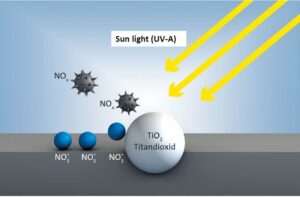
Preliminary tests in Germany and China estimate a NOx reduction of between 15-25%. This means that the new pavement on Vestre Strandvej will have the same air purifying effect as 70,000 m2 of forest.
The work is carried out in collaboration with NCC Industry A / S. The asphalt work is scheduled for execution in week 39 + 40. Traffic diversion must be expected at times.
Contact for further info: Business developer at the Port of Skagen, Jesper K. Rulffs on telephone +45 24 29 43 91 or mail jkr@skagenhavn.dk.
Surface pilot in Oostende, Belgium
DUAL Ports partner, the Port of Oostende, has also initiated a Surface pilot and will realise their pilot in November 2020. The Port of Skagen and the Port of Oostende has been cooperation on the work of the surface pilot, sharing knowledge and experiences. Together, they will are investigating the possibility to develop an assessment tool to follow up on the Surface pilots in Oostende and Skagen.



The MV Shapinsay – subject of the first training course
A course developed in Orkney to prepare local seafarers for working on and alongside hydrogen powered vessels has been approved by the Maritime and Coastguard Agency (MCA).
The approval represents a significant milestone in the Innovate UK funded HyDIME (Hydrogen Diesel Injection in a Marine Environment) project.
The HyDIME project is focused on demonstrating the use of hydrogen as a fuel in marine transport and will see the integration and trial of hydrogen/diesel injection technology on board the MV Shapinsay to power the auxiliary units of the vessel.
The course was developed by Orkney College UHI’s Maritime Studies department, based at the ‘Nav School’ in Stromness and covers such subjects as the specific characteristics of hydrogen and the design and use of the safety features required for storage, transport and consumption of the fuel.
The course, which follows on from an earlier training programme focused solely on handling of hydrogen, will be jointly delivered by both Orkney College and Orkney Ferries staff, providing a credible mix of theoretical and industry input for the best possible outcome.
The transition to zero-emission shipping is part of the UK Government’s Clean Maritime Plan. Work undertaken through the HyDIME project to gain the necessary marine licences and regulatory approvals for hydrogen to be used as a fuel in a marine environment supports this, helping to pave the way for future marine hydrogen projects across the rest of the UK.
Green hydrogen is produced using renewable electricity via electrolysis of water (H2O), splitting water into its component parts of Hydrogen (H2) and Oxygen (O2).
The hydrogen can then be used as a fuel for various end uses, helping to decarbonise across heat, power and transport.
Working with a wide variety of partners from the rest of Scotland, UK and Europe, Orkney is playing a pivotal role in the demonstration of green hydrogen technologies through a variety of projects including Surf N Turf and BigHIT, which will help in meeting carbon reduction targets and supporting the further development of renewable energy technologies.
Councillor Graham Sinclair is Chair of the Council’s Development and Infrastructure Committee. He said: “Once again, we see Orkney punching above its weight at the cutting edge of renewables. This latest development means that we now have the resources and expertise here in Orkney, not only to deliver the crews, vessels and local project management but also high-quality certificated training.
“It is significant that this training will potentially be rolled out nationally, based on the projects being developed right here.
“I congratulate our staff on the work they have put in to meet the very exacting requirements set by the MCA.”
Principal of Orkney College UHI, Eddie Abbot-Halpin, said: “Orkney College is pleased to be working in partnership with Orkney Ferries in delivering this innovative project, which contributes to keeping Orkney at the leading edge of development.”
The Orkney College UHI Maritime Studies Department, on its own pier in Stromness, has been training seafarers for over 50 years and works closely with the local renewables fleet and the industry around it. The department offers a range of short courses to meet the needs of the fishing and merchant-marine sectors and the latest regulations. The department also provides land and marine based engineering training, incorporating the College’s Engineering Department.
Many of the college instructors are currently serving at sea as well as providing training at the department when on shore providing the department with a team who are right up to date, highly motivated and aware of modern training needs.
Further details on projects:
HyDIME
HyDIME is focused on the use of hydrogen as a fuel in marine transport and will see the design and integration of a hydrogen/diesel dual fuel conversion system on a commercial ferry operating between Kirkwall and Shapinsay.
The project will also gain the necessary marine licences and regulatory approvals for hydrogen to be used as a fuel in a marine environment which will have a significant impact on future hydrogen marine projects across the rest of the UK.
More details – HyDIME project website
HySEASIII
HySeas III is the final part of a three part research program that began in 2013 looking into the theory of hydrogen powered vessels (HySeas I), followed by a detailed technical and commercial study to design a hydrogen fuel cell powered vessel (Hyseas II 2014-2015). Several stakeholders has been involved in the project including the Interreg North Sea Region project DUAL Ports and Orkney College.
HySeas III builds on the first two parts by aiming to demonstrate that fuel cells may be successfully integrated with a proven marine hybrid electric drive system (electric propulsion, control gear, batteries, etc), along with the associated hydrogen storage and bunkering arrangements. The project will do this by developing, constructing, testing and validating a full-sized drive train on land. Should this test be successful, Scottish Transport have agreed to fund the building of a roll-on roll-off passenger ferry which will integrate the entire hydrogen/electric drive train which will be subject to extensive monitoring and testing. The chosen route for this innovative vessel will be Kirkwall to Shapinsay in the Orkney Islands.
More details – HySEASIII project website
BIG HIT
The BIG HIT project was initiated in Orkney in Spring 2016. The project was designed to expand upon the concepts as developed by the Surf ‘n’ Turf project.
BIG HIT saw the installation of a 1MW hydrogen electrolyser on the Orkney Islands of Shapinsay, collocated with a 900kW curtailed community wind turbine.
Renewable electricity generated on the islands of Eday and Shapinsay is used by electrolysers to produce hydrogen, by electrolysis of water. This hydrogen is then stored as high-pressure gas in the tube trailers, which can be transported to mainland Orkney.
BIG HIT uses two state-of-the-art proton exchange membrane (PEM) electrolysers. The Shapinsay electrolyser is 1MW capacity and Eday electrolyser is 0.5MW capacity, both located close to the renewable generation assets. The hydrogen acts as an energy-storage medium which can later be converted back into heat and power for buildings and vessels in Kirkwall harbour, as well as the fuel for the operation of zero-emission hydrogen vehicles in and around Kirkwall.
More details – BIG HIT project website
Surf N Turf
Tidal power devices located at the European Marine Energy Centre test site at the Fall of Warness, in the sea just west of the island of Eday, and the Eday Renewable Energy community-owned onshore wind turbine, route their surplus electricity to a 500kW electrolyser, which generates hydrogen by splitting water.
The hydrogen is stored as compressed gas then transported on a trailer by road and sea to Kirkwall, the capital of Orkney. There it powers a fuel cell to generate clean electricity on demand.
Source: https://www.orkney.gov.uk/OIC-News/New-hydrogen-course-developed-in-Orkney-approved-by-MCA.htm
A team of DUAL Ports partners and hydrogen-interested professionals went on a Fact Finding Trip to several different companies investing in hydrogen technologies now and in the future.
Hydrogen has become an even greater interesting opportunity for ports to utilize sustainable energy. Many port’s surroundings provide an optimal position of strong ressources from nature that can help produce green energy, e.g. wind, wave and solar energy. The green energy may not only be used to power homes and business but also to create an alternative to fossil fuels for vessels, ferries, cars, busses among others.
At the end of June 2020, a team of Dual Ports partners participated in a fact-finding tour through Denmark, where they visited several companies involved in the hydrogen industry.
Today, green hydrogen is promoted as one of newer CO2-friendly fuels to be implemented in the shipping industry. More and more different types of ships are considering hydrogen propulsion or the installation of hydrogen fuel cells. From a port perspective, working with this new type of fuel is a challenge but also an opportunity to create new businesses, whereby the ports can play a multiple role. Not only can the port become a storage and bunkering station for green hydrogen, but it can also take up a role in the distribution of green hydrogen and in the production, insofar renewable energy sources are availabe in the neighbourhood.
The fact-finding tour was launched at the port of Hvide Sande. Considering the different sources of renewable energy that are available within the port (wind, solar, wave), the port and the District Heating company are to use the surplus energy for the production of green hydrogen within the scope of grid balancing. Next to the port and the district heating is also the Hvide Sande shipyard committed to build a hydrogen-powered dredging vessel that can be used within the port of Hvide Sande in order to guarantee the maritime accessibility.
The next stop on the tour was the Hy-balance plant in Hobro, a production plant for green hydrogen, that has been realized with European funding. The plant is the result of a cooperation between Hydrogen Valley, Air Liquide, Hydrogenics, Ludwig-Bölkow-Systemtechnik and Centrica. The plant manager gave the delegation a clear insight in the whole value chain of production, storage and distribution of green hydrogen. As to electrolyser, PEM (Polymer electrolyte membrane) technology is used. The whole plant is monitored 24h/24h and 7/7. The fragility of some of the components causes a lot of headaches for the plant manager.
From Hobro, the delegation drove up to Aalborg, where the operation of the hydrogen fuelling station for busses was explained by the project managers, active at the university of Aalborg. The city of Aalborg took 3 hydrogen-powered busses into service in March 2020. The use of these busses will save approximately 60,000 liters of diesel per year and reduce the CO2-emissions by 131 tons annually. In order to produce the necessary green hydrogen, an alkaline electrolyser is used in the plant. Also this pilot project is partly financed by the European Union.
The next was Blue World Technologies, situated at the port of Aalborg. Blue World Technologies is a Danish-Chinese joint venture, where methanol fuel cells are produced in order to replace the traditional combustion engines in cars. Fossil free methanol can be produced through a synthesis of green hydrogen and CO2. According to the managers of the company, the use of methanol fuel cells has a lot of advantages: contrary to electric cars, it can execute a normal travelling range of 1000 kilometers; the refuelling time is very quick, there is a significant fuel cost saving (30% and more) and there are zero harmful emissions. Also the storage of liquid methanol is much easier than the storage of hydrogen. For the production of the hydrogen, PEM technology is used.
The last stop before returning to Copenhagen was the enterprise Green Hydrogen Systems in Kolding. The focus of this company lies on the production of electrolysers, based upon pressurised alkaline technology. According to the CEO of the company, this type of electrolysers have many advantages in comparison with the PEM technology. High efficiency and high durability are 2 selling-points. But surprisingly, this type of alkaline electrolyser is able to handle dynamic operations with variable energy loads. Green Hydrogen Systems is one of the most advanced electrolyser producers in Europe.
About the future of hydrogen in Hvide Sande
Port of Hvide Sande and Hvide Sande District Heating (located on the port area) are looking into the opportunities to create hydrogren from surplus production from their three offshore windmills – and transfer the heat from hydrogen production to Hvide Sande District Heating. Within DUAL Ports, Hvide Sande District Heating is working on the HEAT-pilot and they expect to be 94% CO2 neutral in their energy production with help from a new heat pump.
However, hydrogen is an additional step to reduce the port’s environmental footprints and gain optimal use of green energy. 200 days a year, a dredger works on removing sand from the harbour, so the water depth does not affect the port’s and business’s activities. Hvide Sande Shipyard is working on developing a hydrogen-powered vessel. Negotiations with the Danish Coast Directorate will, however, be crucial for the plans between Port of Hvide Sande, Hvide Sande District Heating and Hvide Sande Shipyard.
During two days, the group visited the following companies (in Denmark)
Port of Hvide Sande
Hvide Sande District Heating
Hvide Sande Shipyard
Hydrogen Valley / Hy Balance
Hydrogen Fuelling Station
Blue World Technologies
GreenHydrogen
The following attended on the Fact Finding Trip
Wim Stubbe, Lead partner of DUAL Ports
Jens Møller, Front Officer of DUAL Ports
Josephine Petersen, Communication Officer of DUAL Ports
Jens Damgaard, Business Development Manager at Business Vordingborg, Partner of DUAL Ports
Bent Haumann, Business Development Manager af Port of Vordingborg, Partner of DUAL Ports
Martin Halkjær Kristensen, Operations Manager at Hvide Sande District Heating, Partner of DUAL Ports
Kasper Teilmann, Consultant at GEMBA Seafood Consulting, Partner of DUAL Ports
Torben Falholt, on behalf of MEQ
Photo-series of the Hydrogen Fact Finding Trip
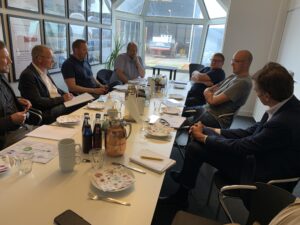
Hvide Sande Shipyard
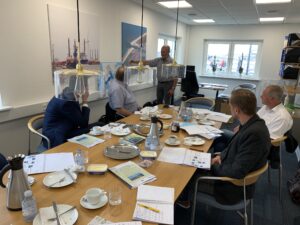
Port of Hvide Sande
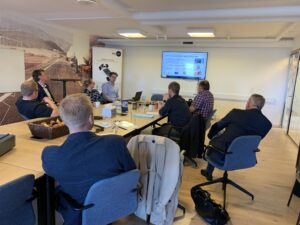
Blue World Technologies
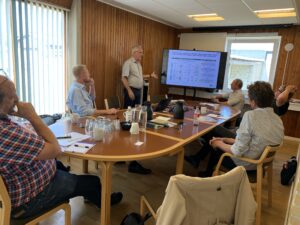
GreenHydrogen
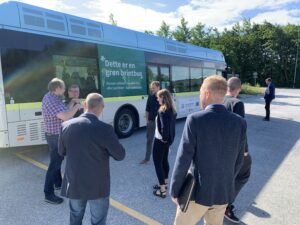
Hydrogen Fuelling Station
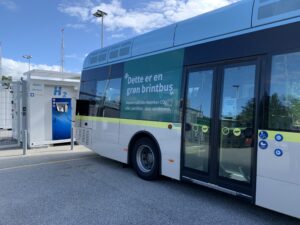
Hydrogen Fuelling Station
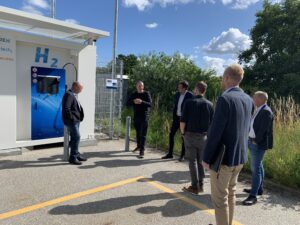
Hydrogen Fuelling Station
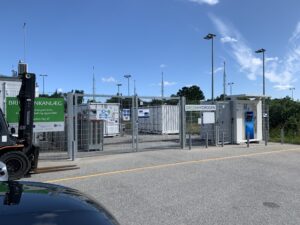
Hydrogen Fuelling Station
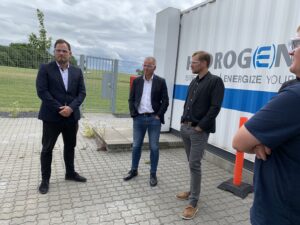
Hydrogen Valley / Hy Balance
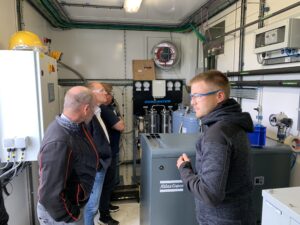
Hydrogen Valley / Hy Balance
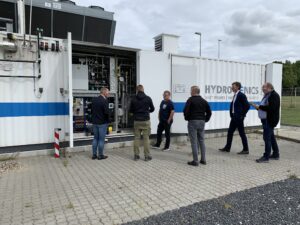
Hydrogen Valley / Hy Balance
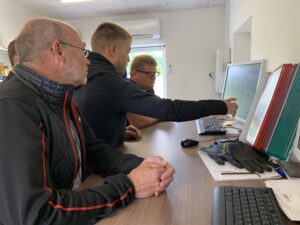
Hydrogen Valley / Hy Balance
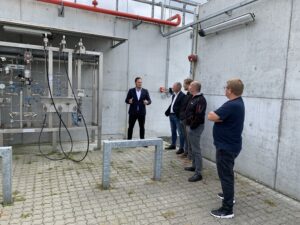
Hydrogen Valley / Hy Balance
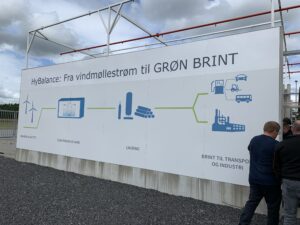
Hydrogen Valley / Hy Balance
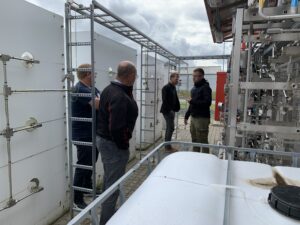
Hydrogen Valley / Hy Balance
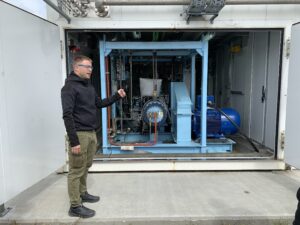
Hydrogen Valley / Hy Balance
Dual Ports partner: ITM Power
ITM Power manufactures integrated hydrogen energy solutions to enhance the utilization of renewable energy that would otherwise be wasted. As a DUAL Ports partner, ITM Power uses its skills in hydrogen technologies for their work in the hydrogen pilot at Orkney Islands.
ITM Power has been strengthening its position in the marine fuel bunkering market by offering the go-to green hydrogen production technology for large scale adoption of hydrogen fuel bunkering for the maritime industry. Its proven electrolyser platform architecture is designed to be scalable.
ITM is preparing itself for the second phase of the GIGASTACK project, a renewable hydrogen project that will be realized in the Humber region. The GIGASTACK project, led by ITM Power, Orsted, Phillips 66 Limited Humber Refinery and Element Energy (consulting) will show how renewable hydrogen, derived from offshore wind (Hornsea wind park) can support the net zero greenhouse gas emission target in the UK in 2050. During the first phase of this project, ITM Power has developed designs for a low-cost modular 5-Megawatt electrolyser stack, whereby Orsted has investigated the potential synergies with offshore wind farms. During the second phase, the partners will detail the actual design of a hydrogen production system, connected to an offshore wind farm and an industrial off-taker, utilizing ITM Power electrolyser stack technology.

Electrolyser from ITM Power
The continuing innovation in ITM Power’s technology, the scale of products alongside the improvements in manufacturing and production volume, position ITM Power to offer products that provide its clients with the best opportunity to make renewable green hydrogen. This green hydrogen will be able to compete on cost with fossil fuel derived hydrogen, and even natural gas by 2050, as forecast by Platts, Bloomberg New Energy, The Hydrogen Council, and Hydrogen Europe. Therefore, it is essential to meet the large-scale green hydrogen production and cost targets that will be essential for shipping.
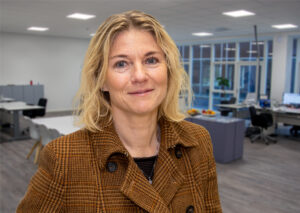 A new opportunity has emerged for director of Business Vordingborg, Susanne Kruse Sørensen. After the summer, Susanne will fulfill Esbjerg Airport’s ambitions as their new airport manager (Denmark).
“There is great potential in further developing Esbjerg Airport, which arouses my interest. And it is, among other things, my work at Business Vordingborg that I will bring with me as I begin a new exciting chapter in my career,” says Susanne.
Business Vordingborg is Communication Officer of DUAL Ports. Susanne Sørensen and Josephine Petersen, Marketing Consultant at Business Vordingborg, are responsible for the communication task. After Susanne’s departure, Josephine will continue the work within DUAL Ports

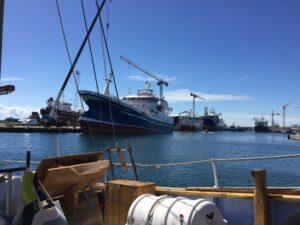 The Port of Skagen has developed a platform for stage 3 of the port expansion that is expected to be finished in the fall of 2020. The primary objective of the port expansion if to create even greater and better framework for one of the ports key activities; fishing, the fishing industry and industry that follows fishing naturally.
The Port of Skagen is the largest fishing harbour in Denmark which position is further strengthened with the port expansion.
Follow the port expansion live
The Port of Skagen has installed webcams that is live all hours of the day. From the video, you can follow the port expansion live from 4 different angles.
See the live footage here: http://www.skagenhavn.dk/dk/havneudvidelsen/webcam
Status of April 2020
The Port of Skagen started the port expansion in July 2019 and has come a long way since.
-
New land is established, 2,200,000 m3 of sand material pumped into 190,000 m2 of land
-
970 m2 of new stone throwing has been established
-
Anchoring of quay 40 completed
-
Hole head hit completed Raming of quay 41/42 is completed, anchoring has started
-
Excavation of existing east mill and cassion mill is ongoing
-
Establishment of the quay at the south pier has been completed
You can see a panorama image of the port from April 28th 2020 here: https://momento360.com/e/u/550d3bf34a3344e698d980b0755f5084?utm_campaign=embed&utm_source=other&heading=0&pitch=0&field-of-view=100
The Port of Skagen publishes videos about its progress on a regular basis. You can see the video from April 2020 here: http://www.skagenhavn.dk/dk/havneudvidelsen/videostatus
 DUAL Ports partner Hamburgerisches WeltWirtschafts Institut (HWWI) has published a report about Cost benefit analysis (CBA). CBA is a systematic approach to compare the costs and bene-fits of alternatives, e.g. a decision between the construction or non-construction of a traffic light, in order to assess the welfare change. The purpose of a CBA is to facilitate a more efficient allocation of resources, mainly in terms of investments decisions. In order to assess the performance of the low carbon port development investments funded within the DUAL ports project, CBA can be applied.
Visit HWWI’s website where you can download the report: https://www.hwwi.org/publikationen/policy-paper/publikationen-einzelansicht/developing-low-carbon-port-potential-cost-benefit-carbon-footprint-analyses.html?no_cache=1
DUAL Ports partner Hamburgerisches WeltWirtschafts Institut (HWWI) has published a report/action plan that address the questions how ports can increase their efficiency, enhance their role in the industry, and become more sustainable. After presenting low carbon port activities within the DUAL ports project, the paper will derive implications for low carbon emission policies.

Visit HWWI’s website where you can download the report: https://www.hwwi.org/publikationen/policy-paper/publikationen-einzelansicht/action-plan-low-carbon-regional-ports.html?no_cache=1
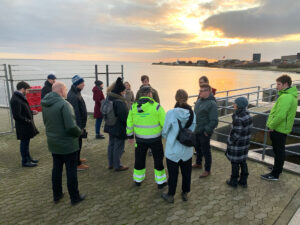 Last week, the Port of Hvide Sande and Hvide Sande District Heating hosted a DUAL Ports’ summit, where 50 partners and guests participated to discussed the future of sustainable energy solutions for port areas. And on this occasion, the two hosts also presented their own goals for the future in Hvide Sande.
The location of a port can help realize the potential of many green energy technologies that we are already using today and those who will become more significant in the future. The Port of Hvide Sande has already come a long way in their sustainable development. The location at the west coast of Jutland offers obvious opportunities for energy production using wind, solar and the energy in the air which are the elements that will help reduce hvide Sande District Heating’s CO2-emissions by 94% within a year.
The start of a strong collaboration
The cooperation between Port of Hvide Sande, Hvide Sande District Heating and the many other companies on the harbor extends for some years.
Steen Davidsen, port director at Hvide Sande Havn, says: “In the mid-’00s, the Port of Hvide Sande was in a situation where our sailing conditions had become very poor. Low water depth and very unstable sailing conditions meant that our largest fishing vessels could not land their catch here. They had to fish at other ports, and so the Port of Hvide Sande lost a large part of their revenue. ”
A 2010 catchment analysis showed Steen and his colleagues that a fish’s value is typically quadrupled. Its turnover value thus becomes four times as great for the port and local businesses as the fish is put for sale, the fishing boats are serviced by electricians and blacksmiths, fishermen purchase supplies and many other conditions. As a result of the fishing industry turned to other ports, both the Port of Hvide Sande, the city and the areas’ general business environment lost a big revenue.
“That is why we started looking at how we could improve the situation. The Port of Hvide Sande and three of the large companies, incl. Hvide Sande Shipyard, teamed up with Municipality of Ringkøbing-Skjern and together they agreed to develop a project to improve the conditions that were obstructing the fishery so that the fishing vessels could come back again,” says Steen Davidsen and continues.
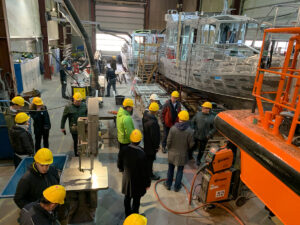
“At the same time, the fleet of fishing vessels had become bigger over the years and the number of active vessels was reduced, so many companies at the port had begun to grow new business areas. Still in the maritime business, but for example Hvide Sande Shipyard had started to produce transport equipment for Vestas. At management level and the board of directors, they saw the need for developing other business areas to maintain the dynamics and development of the port. Can we get coaster traffic? Can we play a larger role in other areas within offshore wind?”
The road to green energy
As the companies at the Port of Hvide Sande began to develop and find new business areas, it also placed greater demands for the port area that needed an expansion. And to that end, the Port of Hvide Sande had a plan that also meant a sustainable energy solution.
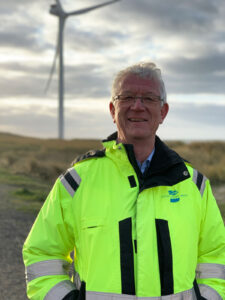 Steen Davidsen explains: “The wind is a very obvious resource for us on the west coast. If we could carry out a wind turbine project, then we could finance a part of the port expansion we needed. We could also become self-sufficient with electricity for the many summer cottages that use electricity, and that was also a story that tourism organizations saw opportunities in. The project had the potential for improving image and branding for the tourism industry and port companies.
The windmills were in service at the beginning of 2012, and by the middle of 2013, we had a new port and new facilities, and so it was very logical for the original companies to explore how the new facilities could be better utilized.”
The wind turbine project boosted the port’s development and the companies’ growth opportunities. And the collaboration that had already begun inspired the possibilities of creating even greater cooperation.
“In 2011, we invited all companies interested in the port’s activities and asked: Do you want to join a collaboration? The agreement between the companies created Hvide Sande Service Group, which is a network of business enterprises whose purpose is to make us attractive in relation to new facilities so that we can grow new business areas. And that is the foundation on which we have worked,” Steen Davidsen says and continues.
“The companies work in and across groups, and this has, among other things, developed Hvide Sande Supply, which is now an agent and stevedore company that establish contact between the calling vessels and local companies for services such as unloading, loading, customs clearance, forging work, food, lodging and much more. It has also helped make the Port of Hvide Sande more attractive as a freight and traffic port. The collaboration with Hvide Sande Shipyard and Hvide Sande Supply also inspires us to seek new opportunities. How can we achieve greater value for one another? And how can we together deliver something externally in terms of service and products that are of interest?”
It was also in 2015 that the Port of Hvide Sande and Hvide Sande District Heating saw their opportunities for cooperation. And precisely this collaboration has initiated their participation in the DUAL Ports project to find sustainable energy solutions for the port.
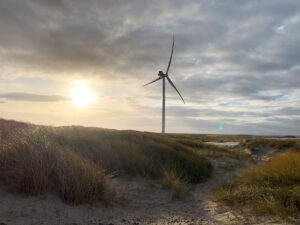 Steen Davidsen says: “A natural consequence of the wind turbine project has initiated the project with Hvide Sande District Heating, which is a major tenant at the port, and who could see the value in acquiring the wind turbines and creating a better, cheaper, sustainable and renewable heat production for the entire area. Together, we also found the area for the solar panel plant in the port area, and this is how we started a strong partnership about a green project that benefits the entire area. Together we create a very high degree of self-sufficiency in the energy field and on an extremely sustainable basis. It has been natural to develop further.”
Responsibility for own development
Since the mid-’00s, the Port of Hvide Sande has been through a great development – both in their local business and in development of sustainable energy solutions. And it has especially been cooperation and responsibility that has driven their growth and success.
“The special thing about the Port of Hvide Sande and our area is cooperation and unity – joint responsibility for our own situation and development makes us strong. It was therefore quite natural for us that if we were to have wind energy here at the harbor, we should do it in a way where we make our own decisions. That is why we created our own private trader fund, which can buy goods wherever they want and which, of course, bought Vestas mills because they were the ones we needed to support the ownership that the whole area has,” says Steen Davidsen.
Steen Davidsen continues: “Fishing is our DNA – and the wind as a resource has become part of it. There is a huge wind industry, and the biggest workplace nearby is actually Vestas in Ringkøbing and Lem on the other side of the fjord. Many of the formerly active in the fishing industry have, after a structural adjustment, been given work in the wind turbine production, where they either work at Vestas or one of their subcontractors.
And it is no coincidence that Vestas has emerged out here. The west coast of Jutland is where we have the larger amount of wind, which means that some people once thought that it can be used to produce wind energy.”
Ambitious goals
In a year, the Port of Hvide Sande and Hvide Sande District Heating will achieve the target of being 94% CO2 neutral in their energy production with help from a new heat pump.
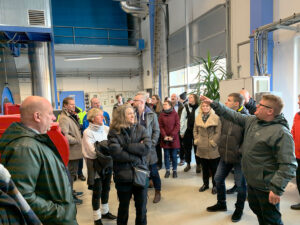 Martin Halkjær Kristensen, operations manager at Hvide Sande District Heating, adds: “The new heat pump can produce 4.6 MW, but it will only use 1.3 MW of electricity to achieve full power. So it only needs 1 part of electricity to produce 3-4 parts of heat, which is an increased power rate of 300-400 percent.”
Together, the two local organizations have worked to reach the ambitious climate target, but there are no worries about meeting the deadline within a year.
“It is a fully achievable goal. Hvide Sande District Heating has expanded their area and prepared their facilities, and once the new heat pump is installed, they are self-sufficient in energy parts. When the project is complete, we expect the total CO2 reduction to amount to at least 6,300 tonnes of CO2 annually, which is a 94% reduction,” says Steen Davidsen.
Hydrogen in the future
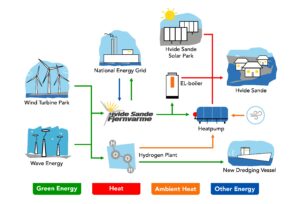
But Hvide Sande District Heating cannot use the entire energy production from the three wind turbines at the Port of Hvide Sande. Today, excess electricity from the mills is being sold, and it has fueled the consideration of producing hydrogen from surplus production. It allows you to use the energy when you need it and not when it is produced. And there is a clear plan for hydrogen in the future.
Martin Halkjær Kristensen from Hvide Sande District Heating explains: “The excess wind energy can be utilized for hydrogen production, which will be used locally. The residual product in hydrogen production is actually heat that can be used for district heating production, so we can achieve a sustainable, circular infrastructure where renewable energy is recycled.”