DUAL Ports partner Madadh MacLaine of Fair Winds Trust has been on the road, participating in different conferences on propulsion and future fuels, promoting DUAL Ports and the use of hydrogen and wind propulsion in commercial shipping.
3rd International Conference on Marine Renewable Energy and Maritime Hydrogen Technology Florø, Norway
At the International Conference on Marine Renewable Energy and Maritime Hydrogen Technology in October, focus was on providing the latest updates on technology, policies, projects and business cases within the subsea, marine renewable energy and maritime hydrogen industries. DUAL Ports was mentioned at the conference by a sister project, HySeas III, presented by the energy provider company Ballard. Madadh MacLaine participated in the conference representing DUAL Ports, and was met by interest from other ports and potential stakeholders, who were interested in learning more about the project.
IBIA Annual convention Copenhagen, Denmark 2018
IBIA stands for the International Bunker Industry Association who had their annual conference in the beginning of November. At this conference Madadh MacLaine and DUAL Ports had been invited to speak about future proof fuels. As lead partner of the SAIL pilot and as Business Development Manager at ITM Power, Madadh MacLaine presented on hydrogen as a marine fuel and participated in a Q&A with the interest of promoting the use of wind propulsion in commercial shipping. People from the fuel industry showed great interest in alternatives to conventional fuels, and are open to discuss the possibility of using hydrogen and other more sustainable fuels for future shipping.
The Motorship Propulsion & Future fuels conference Hamburg, Germany 2018
Hydrogen, when produced from renewable energy, is truly a zero-emission fuel. At the Motorship Propulsion and Future Fuels conference, Madadh MacLaine presented the possibilities for using Hydrogen in the future fuel mix. Hydrogen can be used in fuel cells, as a direct fuel or as a mix with diesel for co-combustion. MacLaine also took part in a Q&A session on the safety of future fuels, along with DNV GL, an international risk management company working with safety in the maritime sector, oil and gas, and energy.
In a world where sustainability is increasingly in focus and ships are growing in size and volume, is there a future for smaller, regional ports? A workshop hosted by the North Sea Region funded project DUAL Ports provided some interesting answers.
By Sofie Forfang, nortseablog.eu, Joint Secretariat, North Sea Region Programme
On 10 October, the DUAL Ports project held a workshop in Brussels entitled Innovative green port solutions in small and medium sized ports.
The DUAL Ports project aims to decarbonise regional entrepreneurial ports through a shared eco-innovation programme and runs eight pilots demonstrating green port concepts.
The workshop was organised as a side event at the EU Week of Regions and Cities and brought together key stakeholders in a lively discussion on the greening of smaller ports.
Blue growth – a key driver of European economy
Gesine Meissner, President of the European Parliament’s Intergroup on Seas, Rivers, Islands and special envoy on Maritime Policy, highlighted the role of regulatory frameworks in driving the greening of European ports.
She recognised the role of EU-funded projects like DUAL ports in helping regional ports meet upcoming sustainability demands. According to Meissner, DUAL Ports is ‘a very good project which can really bring us a step forward by stimulating eco-innovation in ports.’
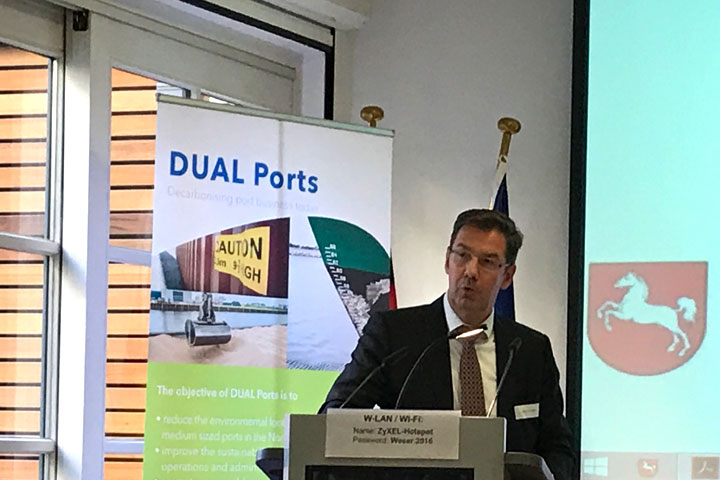
Felix Leinemann of DG Mare agreed, commending the DUAL Ports project for trailblazing solutions that complement other initiatives across Europe. He underlined the growing economic importance of European blue growth, currently with an estimated turnover of 566 billion €, creating minimum 3.5 million jobs and with many emerging businesses driven by new technology e.g. within circular economy, desalinisation, big data, sensors, and autonomous vessels.
Pilots show positive results
Two DUAL Ports pilots were presented at the workshop:
GREEN OFFICER: Sustainability manager at the German Niedersachsen Ports Matthäus Wuckowski presented the pilot’s sustainability strategy that incorporates eco-innovation as well as other aspects such as growth and customer satisfaction. The strategy is now driving numerous types of innovation, such as the installation of an intelligent LED lighting system where lights are automatically switched on when needed.
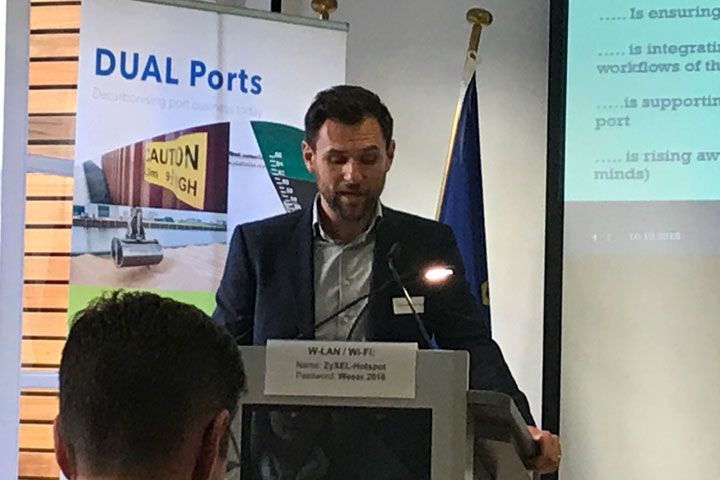
SOIL: Development Manager Jan-Jaap Cramer presented how the Danish Port of Vordingborg is using construction and demolition waste, fly ash, and slag to expand the port. This reduces the cost of the expansion, saves costs of depositing the waste, and speeds up the port construction since the materials are readily available in the local area. Also, recycling local waste material reduces the carbon footprint due to avoided transport.
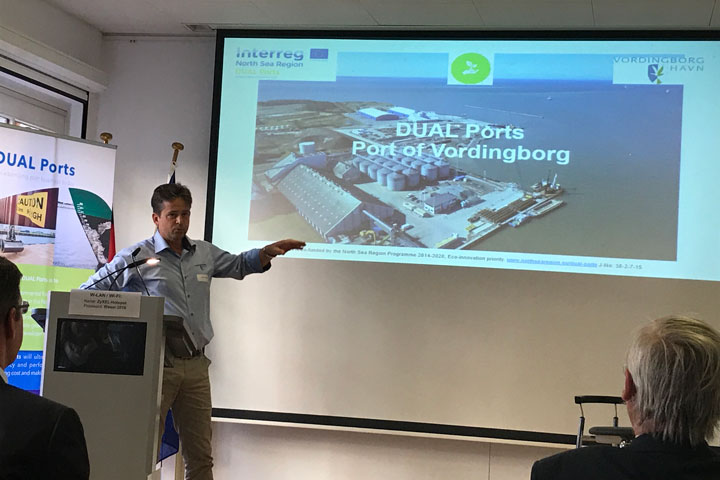
Initial cost-benefit analyses by the Hamburg Institute of International Economics indicate that the money invested into both pilots has been well-spent.
EU frameworks key to greening of regional ports
Much of the discussion revolved around the challenges facing ports can be met and how EU policy and incentive frameworks may help.
Wim Stubbe of the Flemish Port of Oostende, Flanders (the Lead Beneficiary of DUAL Ports) was clear on why EU funding is crucial: ‘Small and medium ports need EU support due to lack of resources and expertise’, he said, explaining that many small ports are run by less than a handful of people.
Sotiris Raptis of the European Sea Ports Organisation (ESPO) called for tax exemptions for shoreside power supply. This would put electricity on a more equal footing with bunker oil and other fossil fuels that are currently exempt from energy tax when used for shipping.
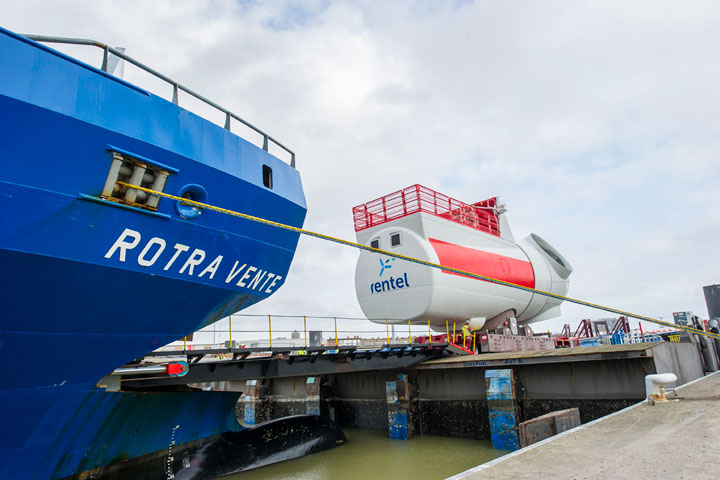
However, it can be difficult for smaller ports to attract electricity companies. The company Blue Power Synergy presented a new invention which might solve the issue: A floating, solar-powered device designed to provide power for ships. ‘The EU should provide the platform for realising this kind of invention’, Wim Stubbe suggested.
The strong global trend of supersize sea carriers was also brought up as a core challenge for the smaller ports. ‘What we really need is ships that are smaller, smarter, and lighter. The building of smaller ships should be better incentivised,’ said Jan-Jaap Cramer.
Transnational cooperation bolsters regional ports for the future
Do the trends of supersized vessels and increasing sustainability requirements put the future of regional ports at stake? Not necessarily. Smaller ports are still needed for effective hinterland transport and also have a role to play in the local community, e.g. by catering to off-shore energy facilities. And as DUAL Ports shows, transnational cooperation helps the smaller ports make headway and innovate for sustainability, in a way that is tailored to their needs.
Delegates found that transnational cooperation speeds up positive development in smaller ports due to the knowledge transfer between partners. Also, the DUAL Port pilots form a basis for further initiatives reaching into the future. For example, Niedersachsen Ports’ sustainability strategy has paved the way for a systematic approach to eco-innovative port development and has led the ports to set green targets for 2025, e.g. for the launch of hydrogen utilities.
The pilots also inspire other ports. According to Wim Stubbe, the eco-innovation efforts of the Port of Oostende are already garnering significant attention: ‘We have at least two visits every month from foreign delegations. Even people from India and Taiwan come to learn about our activities.’
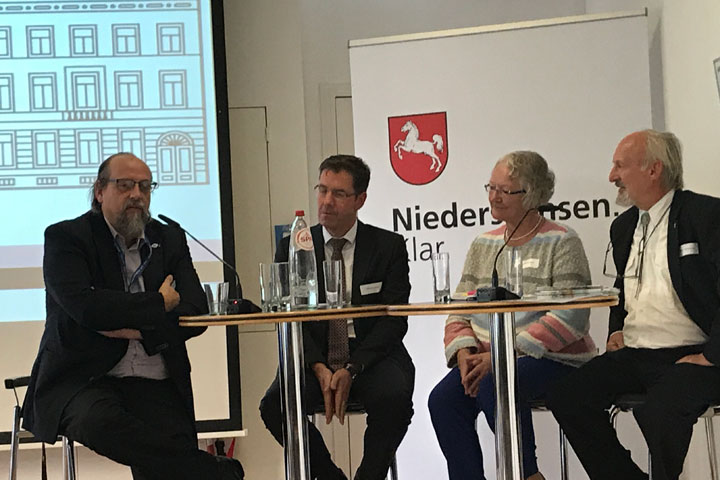
The workshop thus revealed that there is both a challenge and an opportunity for smaller ports to diversify, to specialise and even to become a laboratory for innovation in logistics, port management and blue growth.
You can read more about EU funded projects on the North Sea Region blog here.
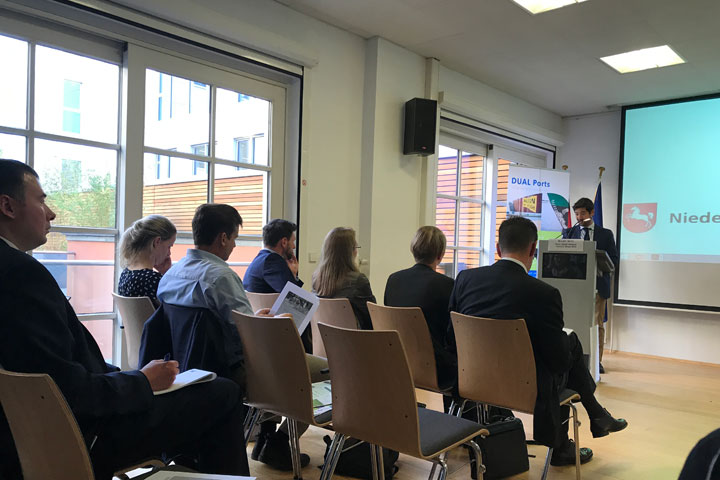
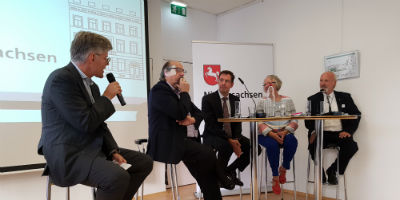 On October 10, DUAL Ports had organized a workshop in Brussels, during the EU Week of Regions and Cities. 25 participants from the maritime industry, EU policy representatives and partners of DUAL Ports spend the afternoon learning about innovative green port solutions, and had fruitful discussions about how to tackle challenges in greening port business.
Felix Leinemann, Head of Unit Blue Economy Sectors, Aquaculture and Maritime Spatial Planning in DG MARE addressed the opportunities for Blue Growth and informed the interested listeners that blue economy is growing exponentially compared to other sectors. Developments in new technologies and digitalization, underwater robotics and innovative aquaculture creates a great potential for growth. He also stated the importance of ecological management – taking the environment into consideration during this vast development. As he put it – “We cannot make a profit, if we do not keep the sea healthy”.
The growing industry is also one of the main motivations for the existence of DUAL Ports, which has the objective of making small and medium sized (SME) ports more sustainable, but also more competitive. In a growing economy and with large investments in new technologies, SME ports often struggle with limited funds and staff. In order to tackle this, DUAL Ports works to develop methods and test concrete measures that will save both cost and carbon emission, for the benefit of the ports.
The audience was given a short presentation of three DUAL Ports pilots, by representatives of Port of Vordingborg, Denmark and Niedersachsen Ports, Germany. The pilots on sustainable and intelligent ports lighting, sustainable port management and port extension with waste materials demonstrated how these challenges are being tackled by SME ports. The session was followed by a debate between the speakers and the audience about how to improve conditions, to make sustainable ambitions more doable for small ports. Some of the main topics for discussion were the technologies available today and the legislation that needs to follow, and adapt to new methods and framework conditions. Also, the audience addressed questions related to funding – particularly why funding is often earmarked for large ports who already have resources – opposed to small ports, with limited financial and staff resources. The solution is still to come.
The keynote speaker, Gesine Meißner, President of the European Parliament Intergroup Seas, Rivers, Islands was very positive about DUAL Ports and stated that all ports should be made aware of the findings that have come and will continue to come out of the project.
The workshop was organized by the DUAL Ports partnership; hosted by the Hamburg Institute of International Economics (HWWI), Niedersachsen Ports and Region
The workshop agenda is available here.
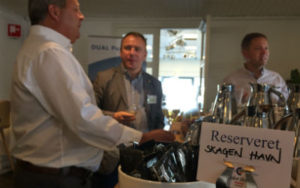
 The Port of Skagen held an LNG workshop as project partner in the Interreg project Dual Ports, which aims to decarbonize the ports in the North Sea region and reduce the environmental footprint.
Nearly 20 contributors were on the workshop’s programme to provide different perspectives and experiences with Liquified Natural Gas (LNG) fuel. The approximately 40 participants in the workshop were both project partners and external companies seeking knowledge about LNG now and in the future.
The Port of Skagen was the organizer of the conference and is working on highlighting the possibilities for establishing an LNG bunker plant at the Port of Skagen, and the outcomes of the workshop were very positive.
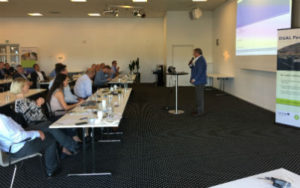 “We have had some very positive expressions from our contributors today, stating that Skagen has an optimal geographical position, making it attractive to invest in LNG bunkering in this area. We will definitely keep working on the business case of installing an LNG facility at the port”, says Willy Hansen, CEO at Port of Skagen.
During the workshop, experiences, ambitions and knowledge was shared from different sectors of the maritime and fuel industry. Lars Persson from Swedegas in Sweden gave his examples on lessons learned as the first country to have a land based LNG bunker station. According to him the future is bright, although there are still challenges for the use of LNG. National legislations and regulations are working towards LNG, but the ports’ own rules and procedures often still provide a challenge – technology is not an issue. Also from Greece, Stefanos Chonianakis from DEPA Public Gas Corporation SA gave examples of a government that is taking many steps towards the support of LNG in Greece.
One of the biggest challenges with LNG bunkering are security issues and lack of knowledge of the actual danger of using LNG. Hanne Hollander, real estate manager from the Port of Emden expressed some of the challenges when investigating LNG options. The German authorities have concerns in regards to potential accidents with LNG. The exchange of knowledge through this workshop revealed that LNG is much safer than many assume. LNG does not burn the same way as a normal fire, and accidents are even much less likely to occur.
During the day, the Port of Skagen had many inputs to work further on, for their pilot project within DUAL Ports.
“Our purpose of being part of DUAL Ports is to investigate the possibilities for an LNG plant in Skagen and make a business case. As a port, we are naturally occupied with providing the right facilities to the port’s customers, and we want to develop the port’s activities in respect to the environment, “says Jesper R. Rulffs, business developer at the Port of Skagen.
You can find presentations from all the speakers here.
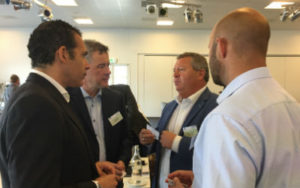
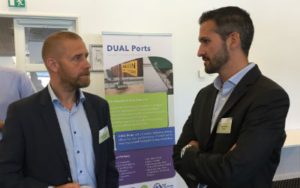
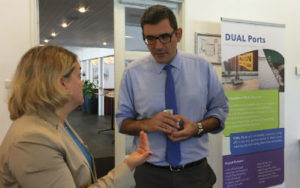
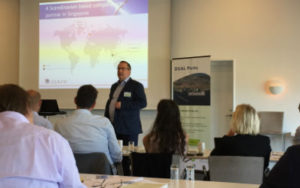
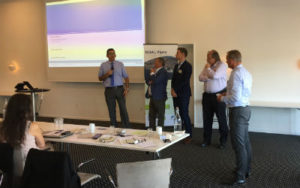
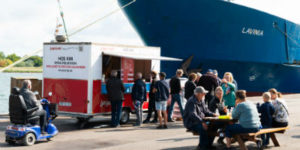
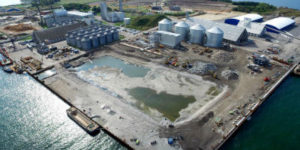 The Port of Vordingborg in Denmark opened up to the public on September 1st, where more than 800 visitors came by the docks and learned much more about the port, the customers and about the sustainable expansion of the quay area.
The Port of Vordingborg invited the public “inside” for an “Open Port”-event on September 1st2018. The many visitors were equipped with a map of the port and were sent on a walk around the port area.
On a marked route, visitors were given the opportunity to get close to the companies that “reside” on the port. At present, 7 companies have settled on the port on the small island Masnedø, in Denmark.
The companies were ready to receive the many guests and told curious citizens more about their production and their reasons for “settling” at the port.
Representatives of the port’s other actors told more about the development projects, and visitors could also come close to the ongoing port expansion, which, with its unique focus on sustainability, attracted great interest.
The port development manager Jan-Jaap Cramer told the many interested more about DUAL Ports and why it is important for the port to think sustainability into the process. The recycling project is going well and the Port of Vordingborg receives very positive reactions from both customers and partners. The port expansion project based on recycling of filling material for the new quayside and a sustainable lighting system has meant that the Port of Vordingborg now finds that both construction companies, customers and other collaborators consider adopting sustainable methods.
There is an important signal value in focusing on sustainability and the DUAL Ports project has helped to visualize the value for both the Port of Vordingborg and the public.
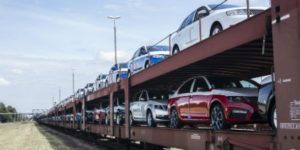 “The right light at the right time,” summarizes Project Manager Aike Wollersheim in a few words the lighting project of Niedersachsen Ports. These days, construction work on the installation of an intelligent lighting system at Eichstraße in Emden begins. A track of six tracks is used there for shunting, parking and loading and unloading of car trains.
The lighting system will be built in this area as an LED system and equipped with an intelligent control system. Motion detectors as well as light and track sensors detect the respective situation. The system can be operated via SMS or an app via a technical remote control and then light is made available where, when and in which light intensity it is actually needed. “We use the potential of digitization to save resources, optimize port operations and relieve the burden on the environment,” emphasizes Holger Banik, Managing Director of Niedersachsen Ports GmbH & Co. KG and JadeWeserPort Realisierungs GmbH & Co. KG.
In the future, the light intensities will be adapted to the different lighting scenarios. Thus, in the idle state, a mean illuminance of five lux is sufficient for e.g. general security and security. For the shunting operation 15 lux are required while in unloading an average thickness of 30 lux is necessary.
“We will install 14 light bridges and 11 single masts in the next few weeks. Suspension ropes and hangers are suspended by two masts, in order to be able to optimally illuminate the lanes between the trains later,” Wollersheim continues. After setting up the masts, the wiring follows in the structures. The programming of the technology and a trial operation complete the construction work. It is planned to go into regular operation this fall.
Track lighting is being implemented as part of the EU-INTERREG project DUAL Ports. The DUAL Ports project aims to collaborate with ports in the North Sea Region to work together on policies and strategies to make ports more sustainable and innovative. A parallel lighting project will be realized in the Danish port of Vordingborg.
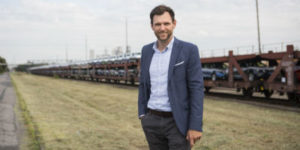 If you would like to now more about the LED pilot, please contact pilot leader Matthäus Wuczkowski, Sustainability Manager at Niedersachsen Ports, +49 441 – 35020-613, mwuczkowski@nports.de
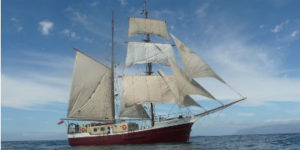 Wind in the SAIL project – partners met in the spring 2018 to discuss and develop ideas that will create new possibilities within the project. The result was a new calculation tool, that will make sail cargo transport more accessible.
Routes by sail are often long and takes more time than direct transport by lorry or plane, so even though transport by sail has close to zero emissions, it is not very competitive. However, a meeting set at the Port of Oostende in Belgium, between partners of DUAL Ports and the Sail Cargo Alliance may have taken new steps to realise the Sail Cargo Network – a DUAL Ports pilot that will facilitate cooperation between cargo owners, ship owners and ports.
Finding the edge
Transport by sail is dependent on wind, which makes routes in the North Sea and the Baltic Sea optimal for sail cargo, due to the short distances and preferable wind conditions. A sailing ship will be able to carry the load equivalent to two lorries and will under these conditions become very competitive.
Therefore, a calculation tool has been developed, that will make it possible for cargo owners and ship owners to calculate the cost for transport. The tool takes different factors into consideration – i.e. weather conditions, passengers, tons of cargo, the price for pilotage and other costs. This will help ship owners to present and negotiate a transparent price to the cargo owners.
During the course of the workshop, this tool was implemented in an online version, that will in the end be able to make it possible for cargo owners and ship owners to find each other and negotiate a price from the calculation.
The first edition will be shown as part of an artistic exhibition at Time’s Up in Malta – a futuristic exhibition, showing how people will likely interact in the future.
“This will give an idea of how the tool will look. We will develop the backend, and in the end, this tool will be able to show where a certain ship is, how much cargo it carries and when it will reach its destination, counting in routes and weather conditions. Cargo owners will then be able to calculate approximate prices and contact the ship owner”, says Madadh MacLaine, founder and CEO of the Fair Winds Trust.
In order to develop and launch the tool, Madadh MacLaine hopes for an extension of the DUAL Ports project, in order to have a test run for two years. If successful, this tool will become a legacy of the project, that will
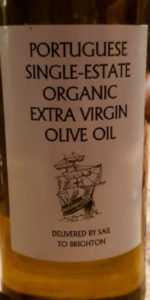 The workshop was followed by a joint dinner, hosted by the Sail Cargo Alliance, where products already being shipped by sail were presented. The guests had the opportunity to taste different wines, rum, coffee and olive oils shipped by sail from Porto, Portugal.
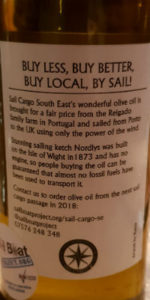 The Sail Cargo Network is thought as a natural choice for manufacturers and consumers, who wish to use a sustainable supply chain from production to end consumer.
The Sail Cargo Alliance
The Sail Cargo Alliance is a group of shipowners and cargo owners that join together to promote and enhance transport by sail.
“An alliance of organisations who share a passion for sail-shipped cargo, working together with shared ethics to create a healthy transport culture that promotes the preservation of the environment for future generations.” – www.sailcargoalliance.org‘
The DUAL Ports project
DUAL Ports is an Interreg North Sea Region project, 50% co-funded by the European Regional Developmental Fund. DUAL Ports consists of 8 different pilot projects that all aim to develop methods and technologies that will make regional entrepreneurial ports more sustainable, and more competitive – www.dualports.eu
The Fair Winds Trust
The Fair Winds Trust is pilot leader of the SAIL pilot in DUAL Ports. The SAIL pilot aims to create a Sail Cargo Network that will connect ship owners, cargo owners and ports, to facilitate the opportunities for sail cargo transport – www.dualports.eu/sail and www.fairwindstradingcompany.org
 The scene was set in June at the northern isles of Scotland – The Orkney Islands. The agenda was the progress of the DUAL Ports Hydrogen Pilot.
Winds were raising, but the sun was high, when the DUAL Ports partnership met in Kirkwall, Orkney, to explore the possibilities of wave, tide and wind energy, and the production and bunkering of hydrogen for ferry vessels. The partnership was welcomed in Scapa, Orkney, by Technical Superintendent David Hibbert, who gave an introduction to the islands and the Orkney Islands Council Marine Services.
The initial point of the Hydrogen pilot, within DUAL Ports, was to develop a business case, where hydrogen for use in cars and shore site operations would be applied to a bunkering system for moving vessels. A hydrogen ferry was a hypothetic idea, at the beginning of the project.
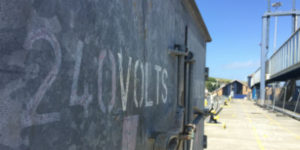 However, Orkney Islands Council are working on different hydrogen projects, and as things develop a hydrogen ferry is now planned to be developed through another project (HySeas III), to be launched in 2020. Therefore, a bunkering system for this vessel has now become a reality and the Hydrogen pilot in DUAL Ports is no longer ‘just a paper project’. ITM Power will be working with Orkney Islands Council Marine Services to assess a number of bunkering options, as well as providing green hydrogen to the ferry, that will result in a ground breaking development for marine transport.
“Within two years’ time, we will have the need for an actual bunkering system, for this new hydrogen vessel. The HySeas III project will develop the world’s first renewables-powered hydrogen ferry, marking a paradigm shift towards entirely emissions-free marine transport,” says David Hibbert, Technical Superintendent of Development and Infrastructure, Orkney Islands Council Marine Services.
Why Hydrogen?
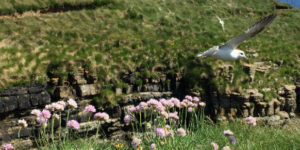 Orkney is an island group north of Scotland, that consists of 70 different islands. The position of the islands make for perfect weather conditions and the islands are self-sufficient in renewable energy due to massive tides going in and out of the North Sea, and preferable wind conditions. In fact, the islands produce more energy than can be consumed, and even more than can be exported to the mainland and the national electricity grid – therefore, efforts are being made investigating and researching how to use the excess amounts of renewable energy on the islands, in order not to waste it.
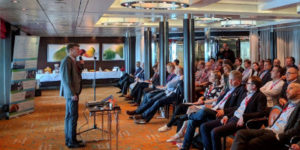 In order to gain a broader network for the upcoming work on LNG, the Dual Ports were present at the 48 hours conference GoLNG Tour on board the Norwegian LNG ferry “Stavangerfjord”.
The conference featured nearly 100 participants from companies and businesses from the LNG Cluster in North Sea and the Baltic Sea. All the participants were there to demonstrate their vast knowledge, cutting edge technologies and newest innovations to the world.
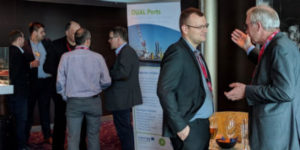 Dual Ports hosted a reception on the conference second day and garnered huge attention. New connections were made and potential pilots to the DUAL Ports from stakeholders in Denmark, Norway and Germany were discussed.
In Denmark the news of the Port of Skagen commitment to LNG sparked the interest of the fishers’ present who are currently looking into LNG options for their upcoming new builds. In addition, Danish ship architects and ship builders also voiced their interest for the DUAL Ports project following the news of the Port of Skagen’s commitment to the project.
Potential investors for the LNG operations in Denmark were also uncovered through conversations with the Danish representatives present at the conference. The two trusts Inseroand Skagen Trustwhere pointed to as potential investors for the project.
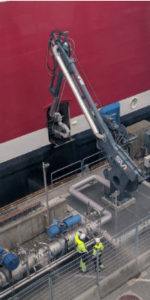 In Norway the company Liquiline expressed a keen interest in providing the LNG solutions for both the Port of Skagen and the Port of Zwolle in order to expand the currently limited LNG Supply network in the SECA area.
In Germany the port of Rostock expressed an interest in joining the Dual Ports project, but also added that in addition to the goals set by DUAL Ports, they would also focus on how to reduce the noise levels in the port as this is a major environmental concern for the port administration.
In total the conference resulted in 29 new connections from various parts of the LNG supply chain, all of whom are interested and willing to help the DUAL Ports project in any way they can.
DUAL Ports will be presented to partners in Interreg Baltic Sea Region, at a matchmaking event sailing between Norway and Denmark.
The Go LNG project & the BALTIC SEA REGION LNG CLUSTER has invited different partners to a “hands-on” International Conference, Study Trip and Matchmaking Event.
The event will be a 48 hour conference onboard Fjord Line’s LNG powered ferry, M/S Stavangerfjord, going from Bergen (Norway) via Hirtshals (Denmark) and Langesund, Oslo (Norway) and back again, while participants can experience and learn more about:
- The latest news on LNG development and technologies
- TTS LNG bunkering
- Guided tour at M/S Stavangerfjord “LNG from the Engine room to the Bridge”
- Matchmaking meetings with leading market players
- Outstanding networking opportunities
DUAL Ports will also board the ship, and you can see the full programme here.