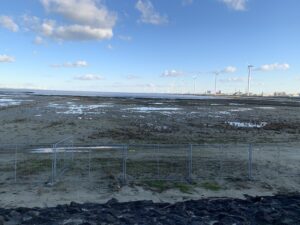
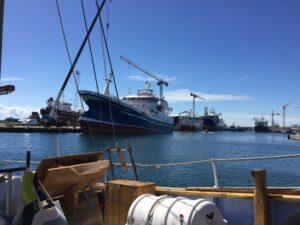
 The Port of Skagen has developed a platform for stage 3 of the port expansion that is expected to be finished in the fall of 2020. The primary objective of the port expansion if to create even greater and better framework for one of the ports key activities; fishing, the fishing industry and industry that follows fishing naturally.
The Port of Skagen is the largest fishing harbour in Denmark which position is further strengthened with the port expansion.
Follow the port expansion live
The Port of Skagen has installed webcams that is live all hours of the day. From the video, you can follow the port expansion live from 4 different angles.
See the live footage here: http://www.skagenhavn.dk/dk/havneudvidelsen/webcam
Status of April 2020
The Port of Skagen started the port expansion in July 2019 and has come a long way since.
-
New land is established, 2,200,000 m3 of sand material pumped into 190,000 m2 of land
-
970 m2 of new stone throwing has been established
-
Anchoring of quay 40 completed
-
Hole head hit completed Raming of quay 41/42 is completed, anchoring has started
-
Excavation of existing east mill and cassion mill is ongoing
-
Establishment of the quay at the south pier has been completed
You can see a panorama image of the port from April 28th 2020 here: https://momento360.com/e/u/550d3bf34a3344e698d980b0755f5084?utm_campaign=embed&utm_source=other&heading=0&pitch=0&field-of-view=100
The Port of Skagen publishes videos about its progress on a regular basis. You can see the video from April 2020 here: http://www.skagenhavn.dk/dk/havneudvidelsen/videostatus
 DUAL Ports partner Hamburgerisches WeltWirtschafts Institut (HWWI) has published a report about Cost benefit analysis (CBA). CBA is a systematic approach to compare the costs and bene-fits of alternatives, e.g. a decision between the construction or non-construction of a traffic light, in order to assess the welfare change. The purpose of a CBA is to facilitate a more efficient allocation of resources, mainly in terms of investments decisions. In order to assess the performance of the low carbon port development investments funded within the DUAL ports project, CBA can be applied.
Visit HWWI’s website where you can download the report: https://www.hwwi.org/publikationen/policy-paper/publikationen-einzelansicht/developing-low-carbon-port-potential-cost-benefit-carbon-footprint-analyses.html?no_cache=1
DUAL Ports partner Hamburgerisches WeltWirtschafts Institut (HWWI) has published a report/action plan that address the questions how ports can increase their efficiency, enhance their role in the industry, and become more sustainable. After presenting low carbon port activities within the DUAL ports project, the paper will derive implications for low carbon emission policies.

Visit HWWI’s website where you can download the report: https://www.hwwi.org/publikationen/policy-paper/publikationen-einzelansicht/action-plan-low-carbon-regional-ports.html?no_cache=1
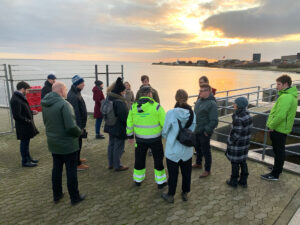 Last week, the Port of Hvide Sande and Hvide Sande District Heating hosted a DUAL Ports’ summit, where 50 partners and guests participated to discussed the future of sustainable energy solutions for port areas. And on this occasion, the two hosts also presented their own goals for the future in Hvide Sande.
The location of a port can help realize the potential of many green energy technologies that we are already using today and those who will become more significant in the future. The Port of Hvide Sande has already come a long way in their sustainable development. The location at the west coast of Jutland offers obvious opportunities for energy production using wind, solar and the energy in the air which are the elements that will help reduce hvide Sande District Heating’s CO2-emissions by 94% within a year.
The start of a strong collaboration
The cooperation between Port of Hvide Sande, Hvide Sande District Heating and the many other companies on the harbor extends for some years.
Steen Davidsen, port director at Hvide Sande Havn, says: “In the mid-’00s, the Port of Hvide Sande was in a situation where our sailing conditions had become very poor. Low water depth and very unstable sailing conditions meant that our largest fishing vessels could not land their catch here. They had to fish at other ports, and so the Port of Hvide Sande lost a large part of their revenue. ”
A 2010 catchment analysis showed Steen and his colleagues that a fish’s value is typically quadrupled. Its turnover value thus becomes four times as great for the port and local businesses as the fish is put for sale, the fishing boats are serviced by electricians and blacksmiths, fishermen purchase supplies and many other conditions. As a result of the fishing industry turned to other ports, both the Port of Hvide Sande, the city and the areas’ general business environment lost a big revenue.
“That is why we started looking at how we could improve the situation. The Port of Hvide Sande and three of the large companies, incl. Hvide Sande Shipyard, teamed up with Municipality of Ringkøbing-Skjern and together they agreed to develop a project to improve the conditions that were obstructing the fishery so that the fishing vessels could come back again,” says Steen Davidsen and continues.
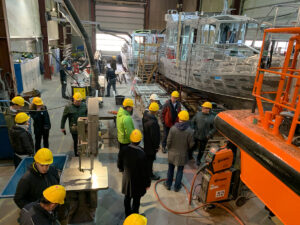
“At the same time, the fleet of fishing vessels had become bigger over the years and the number of active vessels was reduced, so many companies at the port had begun to grow new business areas. Still in the maritime business, but for example Hvide Sande Shipyard had started to produce transport equipment for Vestas. At management level and the board of directors, they saw the need for developing other business areas to maintain the dynamics and development of the port. Can we get coaster traffic? Can we play a larger role in other areas within offshore wind?”
The road to green energy
As the companies at the Port of Hvide Sande began to develop and find new business areas, it also placed greater demands for the port area that needed an expansion. And to that end, the Port of Hvide Sande had a plan that also meant a sustainable energy solution.
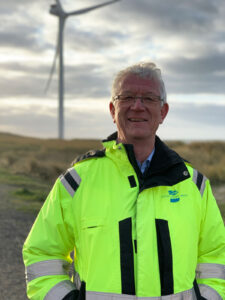 Steen Davidsen explains: “The wind is a very obvious resource for us on the west coast. If we could carry out a wind turbine project, then we could finance a part of the port expansion we needed. We could also become self-sufficient with electricity for the many summer cottages that use electricity, and that was also a story that tourism organizations saw opportunities in. The project had the potential for improving image and branding for the tourism industry and port companies.
The windmills were in service at the beginning of 2012, and by the middle of 2013, we had a new port and new facilities, and so it was very logical for the original companies to explore how the new facilities could be better utilized.”
The wind turbine project boosted the port’s development and the companies’ growth opportunities. And the collaboration that had already begun inspired the possibilities of creating even greater cooperation.
“In 2011, we invited all companies interested in the port’s activities and asked: Do you want to join a collaboration? The agreement between the companies created Hvide Sande Service Group, which is a network of business enterprises whose purpose is to make us attractive in relation to new facilities so that we can grow new business areas. And that is the foundation on which we have worked,” Steen Davidsen says and continues.
“The companies work in and across groups, and this has, among other things, developed Hvide Sande Supply, which is now an agent and stevedore company that establish contact between the calling vessels and local companies for services such as unloading, loading, customs clearance, forging work, food, lodging and much more. It has also helped make the Port of Hvide Sande more attractive as a freight and traffic port. The collaboration with Hvide Sande Shipyard and Hvide Sande Supply also inspires us to seek new opportunities. How can we achieve greater value for one another? And how can we together deliver something externally in terms of service and products that are of interest?”
It was also in 2015 that the Port of Hvide Sande and Hvide Sande District Heating saw their opportunities for cooperation. And precisely this collaboration has initiated their participation in the DUAL Ports project to find sustainable energy solutions for the port.
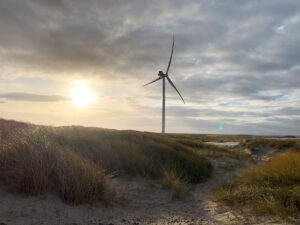 Steen Davidsen says: “A natural consequence of the wind turbine project has initiated the project with Hvide Sande District Heating, which is a major tenant at the port, and who could see the value in acquiring the wind turbines and creating a better, cheaper, sustainable and renewable heat production for the entire area. Together, we also found the area for the solar panel plant in the port area, and this is how we started a strong partnership about a green project that benefits the entire area. Together we create a very high degree of self-sufficiency in the energy field and on an extremely sustainable basis. It has been natural to develop further.”
Responsibility for own development
Since the mid-’00s, the Port of Hvide Sande has been through a great development – both in their local business and in development of sustainable energy solutions. And it has especially been cooperation and responsibility that has driven their growth and success.
“The special thing about the Port of Hvide Sande and our area is cooperation and unity – joint responsibility for our own situation and development makes us strong. It was therefore quite natural for us that if we were to have wind energy here at the harbor, we should do it in a way where we make our own decisions. That is why we created our own private trader fund, which can buy goods wherever they want and which, of course, bought Vestas mills because they were the ones we needed to support the ownership that the whole area has,” says Steen Davidsen.
Steen Davidsen continues: “Fishing is our DNA – and the wind as a resource has become part of it. There is a huge wind industry, and the biggest workplace nearby is actually Vestas in Ringkøbing and Lem on the other side of the fjord. Many of the formerly active in the fishing industry have, after a structural adjustment, been given work in the wind turbine production, where they either work at Vestas or one of their subcontractors.
And it is no coincidence that Vestas has emerged out here. The west coast of Jutland is where we have the larger amount of wind, which means that some people once thought that it can be used to produce wind energy.”
Ambitious goals
In a year, the Port of Hvide Sande and Hvide Sande District Heating will achieve the target of being 94% CO2 neutral in their energy production with help from a new heat pump.
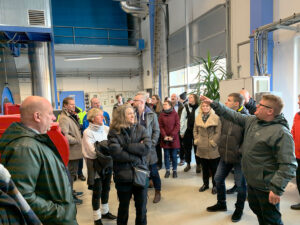 Martin Halkjær Kristensen, operations manager at Hvide Sande District Heating, adds: “The new heat pump can produce 4.6 MW, but it will only use 1.3 MW of electricity to achieve full power. So it only needs 1 part of electricity to produce 3-4 parts of heat, which is an increased power rate of 300-400 percent.”
Together, the two local organizations have worked to reach the ambitious climate target, but there are no worries about meeting the deadline within a year.
“It is a fully achievable goal. Hvide Sande District Heating has expanded their area and prepared their facilities, and once the new heat pump is installed, they are self-sufficient in energy parts. When the project is complete, we expect the total CO2 reduction to amount to at least 6,300 tonnes of CO2 annually, which is a 94% reduction,” says Steen Davidsen.
Hydrogen in the future
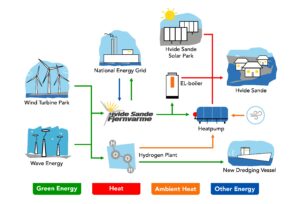
But Hvide Sande District Heating cannot use the entire energy production from the three wind turbines at the Port of Hvide Sande. Today, excess electricity from the mills is being sold, and it has fueled the consideration of producing hydrogen from surplus production. It allows you to use the energy when you need it and not when it is produced. And there is a clear plan for hydrogen in the future.
Martin Halkjær Kristensen from Hvide Sande District Heating explains: “The excess wind energy can be utilized for hydrogen production, which will be used locally. The residual product in hydrogen production is actually heat that can be used for district heating production, so we can achieve a sustainable, circular infrastructure where renewable energy is recycled.”
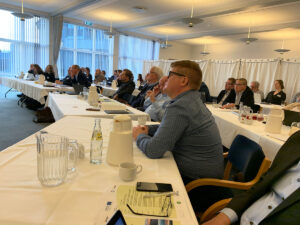
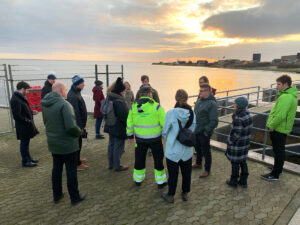
Renewable, circular energy was the topic at the workshop hosted by Port of Hvide Sande and Hvide Sande District Heating.
We have collected presentations from the speakers of the workshop WAVE/HYDROGEN/HEAT workshop, so you have the opportunity to refresh your memory or obtain the knowledge and experiences from the many presentations.
Presentations
Welcome to Hvide Sande and the Port of Hvide Sande,
By Mr. Steen Davidsen, CEO, Port of Hvide Sande, DK
Information about North Sea Region Program and what we can expect in next period,
By Mr. Christian Byrith, CEO, Interreg North Sea Region Secretariat Viborg, DK
DUAL Ports HEAT Pilot – Wave, Solar, Wind, Heat and Hydrogen – making Hvide Sande to a zero-emission city – How we will utilize our position at the coast!
By Mr. Martin Halkjær, Director, Hvide Sande Heat System, Denmark
Windfarms at the west coast of Jutland – Case of wind energy development in the North Sea
By Mr. Arne Rahbek, Director for Communication, Vattenfall, Denmark
DUAL Ports WAVE Pilot – Technology and potential
Case of wave energy development in the North Sea
By Mrs. Irina Temiz, PhD Senior lecturer, Renewable Electricity Production, Division of Electricity, Uppsala University, Sweden
The Wave sector in Northern Europe – Outlook, practical experiences and news.
By Mr. Jens Peter Kofoed, Head of Division, Associated Professor, Department of Civil Engineering, University of Aalborg, Denmark
Wave technology and possibilities – dual or multi tech solutions.
By Mrs. Marcelle Askew, VP Projects, Seabased ab, Sweden
Hydrogen technology and green technology. How do we combine different sources of energy?
By Mrs. Kristina Fløche Juelsgaard, Business Development Director, Ballard Power, Denmark
Hydrogen introduction in Port of Hvide Sande – How we plan to implement hydrogen to ships.
By Mr. Carl Erik Kristensen; CEO, Hvide Sande Ship Yard
DUAL Ports HYDROGEN Pilot experiences. The Orkney island case – how we use green surplus energy and how we are training in the field of Hydrogen.
By Mr. David Hibbert, Technical Superintendent, Development & Infrastructure – Marine Services, Scapa – Orkney, Scotland.
Port and City – How to combine different energy forms in port areas. Renewable Energy Cluster – Norway, The Trondheim Case
By Mr. Ole Svendgård, Fornybarklyngen – Cluster leader, Norway
How we run the Blue-Green development in our part of the world – The GRO case
By Mr. Lars Korsgaard Jørgensen and Mrs. Susanne Trip Nielsen, Ringkøbing-Skjern Erhvervsråd, Denmark
How to create a better environment in Ringkøbing Fjord – The Biomass production Case
By Mr. Kim Iversen, Biologist at Denmarks Center for Wild Salmon, Denmark
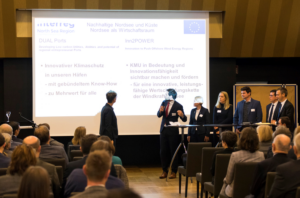
Niedersachsen Ports participated and presented our DUAL Ports project at INTERREG Annual Conference in Bremen.
How can we work successfully in the North Sea Region? That was the overall question of the conference w more than 150 participants on November 12th 2019 in Bremen. The focus was to discuss the value of european network for local development and there was a mutual understanding; european cooperation creates value for both municipalities and regions and local issues can be overcome through cross-country cooperation.
The challenges of climate changes requires a joint effort. Transnational cooperation therefore continuous to be significantly important for the North Sea Region to continue as a sustainable, effective, competitive and attractive area in constant development.
Read the full article here (in German)
Innovative industrial co-siting at the Port of Oostende, Belgium, helps ensuring optimal land-use in ports. But more importantly, it supports business development by offering an area with an overarching environmental permit and safety policy, shared infrastructure, facilities and logistics leading to optimized cost structures and opportunities for circular initiatives.
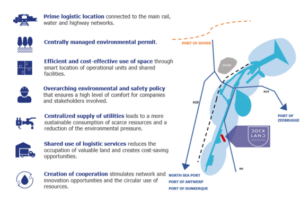 Companies belonging to renewable energy -, storage-, chemical and logistic sector involved in activities with hazardous products are inclined to meet high level safety standards and are thereby subject to permanent control and reporting mechanisms set by the national, regional and local legislators. Dockland offers a robust and sustainable environment in the interest of all stakeholders to preserve business continuity and guarantee opportunities for accelerated entrepreneurial growth within port areas.
Fast entrance to Docklands’ clustered environment at the Port of Oostende is enabled due to the overarching environmental permit which is providing opportunities for companies aiming to easily realize new business projects. This can be opposed to a stand-alone initiative which is much more time consuming. Furthermore, Dockland offers the opportunity to gain access to port areas even with smaller area demands and thus realizing low-barrier access to a prime logistic location in port areas that would otherwise be less accessible, especially for SME’s.
Sustainable, clustering environment
Approximately 100.000 m2 land at the Port of Oostende will be the location of co-siting. The location at the Port of Oostende ensures an efficient and cost-effective use of land through smart location of operational units and shared facilities. In addition, companies can profit from the benefits of a prime logistic location connected to the main rail, water and highway networks, all organized in a sustainable way.
Due to the applied clustering master planning land use is optimized and leads to a substantial increase of the added value per square meters as a result of shared infrastructure and logistic areas. Making use of this shared infrastructure and utilities leads to important cost-reductions compared to a stand-alone situation, while responding to the current societal needs.
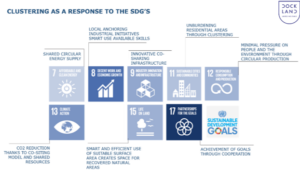
At the same time companies can focus on their core activities and take advantage of clustering opportunities to reduce their CO2 footprint. Cooperation at Dockland will stimulate networking, circular use of resources and opportunities for innovation.
The future of DOCKLAND
A specialized working group in Dockland is managing the complicated administrative task of applying for a permit to cover one site which includes a risk assessment.
However, hopes are high. The neighboring environment, schools and universities were invited to Dockland for an introduction of its facilities and its future plans. The Port of Oostende encouraged the visitors to ask any questions and the business case was well received.
Docklands’ expectation is that they will receive an approved environmental permit in 2021, and companies are already showing great interest about the possibilities and future prospects.
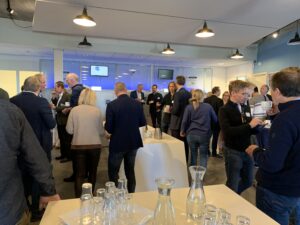
In October, the port companies Niedersachsen Ports and Groningen Seaports hosted the workshop Sediment Management in Ports in Eemshaven, Holland. Experts were invited to share their work on issues concerning an efficient management of sediments and the handling of dredging material in ports. The workshops participants had the opportunity to find answers to questions such as what is the impact of current and future sediment movements in the North Sea and the rivers on the sediment entry into ports and what technological developments promise the highest benefit when it comes to warranting safe access to the ports and improve their ecological footprints?
We have collected presentations from the speakers of the workshop Sediment Management in Ports, so you may also have the opportunity to obtain knowledge on the subject.
The nature perspective: Environmental Effects of Sediment Management by Gregor Scheiffarth and Dr. Inga Nordhaus, Lower Saxon Wadden Sea National Park Authority (DE)
Large-scale sediment transport and morphological modeling as a sediment management tool by Dennis Oberrecht, NLWKN (DE)
General Dredging Introduction and Sediment Logistics by Jef De Brabandere, Adjuvans (BE)
Generating Energy by Gasification of Marine Sediments and Waste by Theis von Appen, EXOY Green Systems Gmb H (DE)
Plastix Flux to the Sea and Innovation Trajectories by Eric Toorman (Devriesa, Lisa), Flanders Marine Institute (BE)
Analysis-Methodology of Event-Driven Sedimentation in a Shipyard by Jan Fischer, Ludwig-Franzius-Institute for Hydraulic, Estuarine and Coastal Engineering (DE)
Building with Nature by Martin Baptist, Wagening Marine Research Ecoshape (NL)
Re-use of Sediment in Port or Coastal Infrastructure by Luca Sittoni, Deltares, Ecoshape (NL)
The EU Project DUAL Ports
Niedersachsen Ports has designed this workshop as part of the European project DUAL Ports, which was initiated in 2015. It is funded by the EU and the Interreg North Sea Program. DUAL Ports brings ports, companies, and scientific institutions from Belgium, Germany, the Netherlands, Denmark, and Scotland to the table. The objective of this collaboration is the joint development of solutions and approaches for the long-term reduction of CO2 emissions and pollution caused by the activities of the port industry. The exchange of knowledge between the partners and the resulting synergies are intended to support and accelerate the development and implementation of sustainability innovations in ports.
Further information about the project DUAL Ports is available here: www.northsearegion.eu/dual-ports and www.dualports.eu
The Workshop-Agenda is available here: https://www.nports.de/fileadmin/user_upload/Sediment_Workshop_Eemshaven_Agenda.pdf
We can all learn from small ports
During the closing session of GreenPort Congress 2019, small ports showcased the steps they have been taking to tackle emissions and build operational environmental awareness with limited resources.
The Port Authority of Skyros in Greece’s Aegean Sea has invested in electric vehicles, an airborne particles station at Linaria Port and runs university and school volunteer programmes as part of its bid to be sustainable.
Planning and committing to environmental initiatives is not an easy task as Kyriakos Antonopoulos, president of the voluntary-run port authority explained. In post since 2005, with no staff and without a salary, Mr Antonopoulos said the “annual budget of the port is only €150,000” and finances have been constrained by “Greek austerity”, while the future of the port is uncertain.
Currently owned by 300 local shareholders resident in Skyros, the port may be privatised and incorporated into a larger port group, Mr Antonopoulos said.
Student volunteers
Still the port has managed to introduce an impressive amount of eco measures into its passenger, commercial and fishing operations. These include annual sea bed clean-ups, regular oil spill exercises, a ship-generated waste management plan, recycling of waste materials and use of electric vehicles. This is alongside work with the University of Patros to set up an airborne particles station.
Skyros’ student programme aims to bring participants back to nature and boost mental health. The eco-therapy-focused Skyros Project enables students to undertake two-month internships and live in an eco-village.
The project became possible when the port formed a relationship with Greece’s University of the Aegean in 2015. Cooperating with universities and volunteers is a feasible way of achieving change for ports with no financial leverage, explained Mr Antonopoulos.
Constantina Skanavis, professor in environmental communication and education at Greece’s University of West Attica, has been working with the port since being in post at the University of the Aegean. Before working with the port, she noted that small ports didn’t have the funding or infrastructure to achieve what bigger ports could and wanted to get students involved in Skyros’ environmental work.
“I was able to convince college students from all over the world to come to this small island and live with us for two months. We showed that by being in contact with the sea, working outdoors, constructing things from nature. All of a sudden they became very happy. Promoting responsible behaviour was my goal,” said Professor Skanavis.
The success of the Skyros project means that it is set to be made into a foundation next year.
This work hasn’t gone unrecognised. In 2018, Skyros secured Blue Flag status, awarded by the Hellenic Society for the Protection of Life Nature, and the Skyros Project won a ‘Minimal waste and Public Choice Award’ as part of the I LIVE GREEN video competition run by the European Environmental Agency (EEA) and its partner network in 2018.
The year before it became part of ESPO’s EcoPorts network, the smallest member to date. It is also part of the Ecocity Forum.
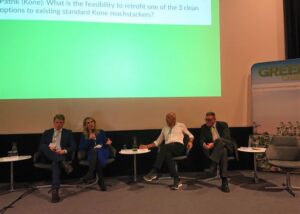
Port of Helsingor
Jonatan Sandager Hansen, project manager at the Port of Helsingor in Denmark explained that the port’s proximity to local communities necessitates careful consideration of air quality and noise levels.
Helsingor, which focuses on ferries, dry bulk and cruise operations, aims to build new quay with shore power. The port currently has small amount of shore power, but not enough to power a cruise ship, explained Mr Hansen.
But while it has ambitious plans for shore power, and currently has an electric tug and hybrid forklift – made possible as equipment manufacturers are offering machinery in different price brackets, it cannot afford to replace equipment on the scale of a larger port, only when current equipment no longer works.
However, is facilitating the reduction of its carbon footprint, wherever possible. It has invested in wind power, accommodates battery-powered ferries and supports short-sea shipping. The port also uses local contractors with the aim of ensuring contractors minimise the distance they drive to cut emissions, and to make sure money spent goes back into the local community, while offering a sense of ownership for local citizens.
“There is a lot being done to make sure emissions and sound are as low as possible,” Mr Hansen said.
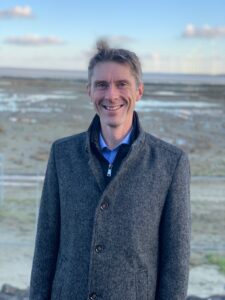
“I look at sediment management from a natural perspective. In the projects I am involved with, I look at sediment as a source to create natural values. To create salt marshes and systems that redefine sediment instead of just throwing it out into the sea and wait to see where it ends up. We can use sediment as a resource to recycle – to make something more beautiful of it.”
Martin Baptist is an engineer and marine ecologist at Wageningen Marine Research and working for EcoShape (NL). His interest in the harmonisation of human impacts with natural processes is central in one of his project which researches on the smart use of dredged sediment for the growth of salt marshes.
Salt marshes are very important ecosystems for several reasons:
- They are breeding and resting places for birds
- They are spawning ground for fish
- They reduce wave impact and protect the coast against erosion
- They trap sediment so the coast can grow
- Salt marshes also capture CO2
But the climate changes and the rise of sea level puts salt marshes under pressure. Martin Baptist is part of a project that investigates the right conditions for salt marsh construction and the best possible ways to develop salt marshes in a natural way.
In this project, the Marconi salt marshes, the EcoShape consortium studies morphological and biological conditions in a constructed salt marsh in large-scale experimental plots. Sand was mixed with dredged sediment in various percentages and parts were sown in with Glasswort seedlings. Knowledge obtained in the project helps the development of climate adaptation measures worldwide.
Another project Baptist is involved with is the ‘Mud Motor’. A Mud Motor is a dredged sediment disposal in the form of a semi-continuous source of mud. Natural processes are allowed to disperse the sediment to nearby mudflats and salt marshes. The Mud Motor is part of the Living Lab for MUD (Multifunctional Use of Dredged sediment) by Ecoshape and its partners that carries out five pilot projects to develop knowledge about the sustainable use of sediment.
The Mud Motor project showed that the feasibility of a Mud Motor depends on an assessment of travel time for the dredger, the effectiveness on salt marsh growth, reduced dredging volumes in a port and many other practical issues.
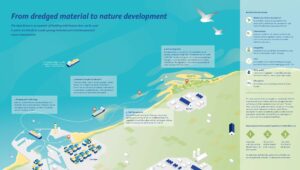
Sediment and salt marshes
Martin Baptist joined us as a speaker at our latest workshop on Sediment Management in Ports to present his perspective on sediment. He shared his research on the beneficial use of dredged sediment to enhance salt marsh development by applying a “Mud Motor” and by constructing salt marshes.
Sediment management is a necessary part of port maintenance and development that ensures ports’ ability to support big vessels and large volumes. The use of dredging technology differs and the most sustainable solution may also differ depending on each port. However, the disposal of sediment is necessary for many ports and can cause issues. Re-using sediment for salt marsh development is a sustainable way of using existing materiale.
Martin Baptists’ research have improved our understanding on transport processes in the channel and on the mudflats and salt marshes and provides guiding principles for future application of sediment management in salt marsh development.