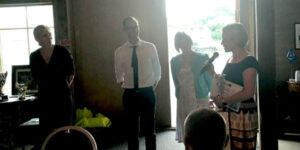
 At the North Sea Climate Conference on the 25th of June, the DUAL Ports partnership was awarded with the runner up for ‘best video’ in the second annual NSR Video Contest. The award was handed over by the President of the North Sea Commission, Kerstin Brunnström.
Lise Espersen from the Interreg Joint Technical Secretariat presented the winner and the runner up for the NSR Video Contest at the opening dinner of the North Sea Climate Conference, that was held in Marstrand, Sweden.
The DUAL Ports project was selected as the runner up between 11 different entries in the competition. The jury consisted of 14 judges, two from each of the membering North Sea countries, appointed by the Monitoring Committee.
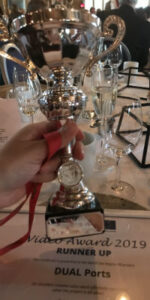
DUAL Ports communications officer Camilla Bruun Sørensen received the award on behalf of the project partnership. After thanking for the recognition, she took the opportunity to thank the North Sea Programme for the extension of the project, which will bring DUAL Ports even further in decarbonizing port business.
The winner of the NSR Video Contest was Inno-Quarter – an Interreg project that facilitates start-ups to develop business ideas in line with the UN Sustainable Development Goals, making products that help tackle climate change by reducing carbon emissions.
You can see the winning videos here and read more about the award show.
The following day consisted of plenary discussions and workshops, focusing on practical measures necessary to tackle climate change.
This year, the youth had been included in the conference and the pre-conference Interwork event with the North Sea Commission. Jamie Wylie from the 2050 Climate Group gave his perspectives on the importance of engaging the future generation in the impacts of climate change – and stressed the fact that young people are also people, who just happen to be young.
 Tomas Kåberger, affiliate professor of Renewable Energy at Chalmers University illustrated how developments in wind and solar energy have exploded within the last 10 years, especially in China, making prices reach a competitive industry level.
Katharina Erdmenger, German representation to the EU, gave an update on the post-2020 discussions in Brussels, and encouraged the audience to continue the positive direction towards tackling climate change, as we are going in the right direction.
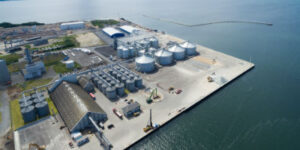 The Port of Vordingborg held their grand opening of the sustainable port expansion on June 22nd. The day was celebrated with an open event for the public, clients and official invitees.
It was a special day, when the Port of Vordingborg opened their new port area. The Mayor of Vordingborg, Mikael Smed, Head of Secretariat at North Sea Region Programme, Christian Byrith, chairman of the Danish Ports association, Ole Ingrisch and CEO of DLG, Kristian Hundebøll gave the opening speeches, focusing on the possibilities that the DUAL Ports project and the port expansion give to the local businesses, the city and the region.
De-velopment instead of de-commissioning
The Port of Vordingborg focuses on development as opposed to decommissioning, which is done by many other Danish ports. The visions of sustainable development now manifest themselves in a literal sense with a port that has become much larger in terms of area and has gained more water depth. Water depth and location are two crucial factors that make the port business attractive – both today and in the future with the establishment of a new Storstrøm bridge in the region.
Sustainable port expansion
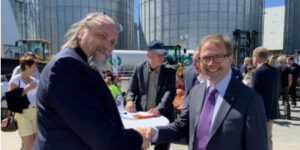 The Port of Vordingborg has received great recognition both nationally and internationally in the industry. The port expansion is part of the EU Interreg project DUAL Ports, where ports in the North Sea Region work together to develop methods and technologies that will make port operations more sustainable. Visionary and sustainable development is a valuable brand at a time when climate is in focus.
Investing in the port is an investment in the municipality
The Port of Vordingborg is happy and proud to contribute to the visibility of the area and to support both the local and general business development. There is great interest in the port from companies in relation to the opportunities that have arisen based on the port expansion and the port’s geographical location. Also, local associations, networking groups and educational institutions have shown great interest in the port, and there have been plenty of guided tours in the last few months. The interest in investment strengthens both the Port of Vordingborg but also has a spill-over effect elsewhere in the municipality.
During the day guest could take a walk around the port, learn more about the new bridge construction, that is taking place on the southside of the port area, see the port from the seaside on a military vessel, MHV 803. The DUAL Ports project was also represented at the port and talked to many of the visitors who showed interest in the international aspect.
You can see photos from the opening and read the article from a local newspaper, Sjællandske, here.
The event was also covered by Danish regional Tv2Øst – you can see clips from the day here.
 After many years of lobbying it has now been decided that the locks of Afsluitdijk in the Netherlands will be widened. The widening of the locks will have a major impact on the feedering of cargo from and to the major ports and on the development of the port of Zwolle.
This great news will have a positive impact for DUAL Ports partner Port of Zwolle.
The locks at Afsluitdijk will be widened from 11 to 25 meters and this will make it possible for larger ships to come into the inland ports of the region, including the Port of Zwolle. The decision to widen the locks will also create a lot of new investments, mainly from local companies and ship builders in the area, investing in new and larger machinery and staff.
With calculations, permits and construction, this decision will have a long-term impact, and results will not be seen in the first couple of years. However, it is an important step towards greater development in the Dutch region. The widening of the locks can make the ports of Zwolle and Kampen an attractive logistical spot for transport of bulk goods, containers and packages, which will create growth.
You can read the entire article (in Dutch) right here.
On the 23.-24. of May ESPO held its annual conference in Livorno, Italy.
A memorandum emphasizing “Priorities of European Ports for 2019-2024” has been published by ESPO and was presented at the conference in Livorno.
“The memorandum explains how ports can contribute to Europe’s competitiveness. It’s more than just a shopping list of what Europe needs to do or not for European ports.
European ports are the entry gates for trade, are at the crossroads of supply chains and are hotspots of energy, industry, innovation and digitalisation. We believe that European ports are a strategic partner in achieving Europe’s goals in terms of digitalisation and decarbonisation.” says ESPO’s secretary general Isabelle Ryckbost.
You can read more about the memorandum here.
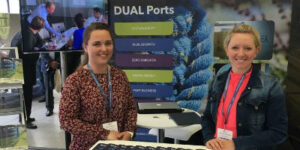 The European Maritime Days were held in Lisbon, Portugal on the 16-17thof May 2019. The DUAL Ports project was represented at the conference as the only Interreg project from the North Sea Region.
”The focus in 2019 was on blue entrepreneurship, research, innovation and investment to boost sustainable technologies and emerging value chains in the wider ocean economy.” European Maritime Day
More than 1400 participants had registered for this year’s conference, and many interested people in the maritime industry and from the European Commission stopped by the DUAL Ports corner.
The annual conference is organized by the European Commission, this year in correlation with the Portuguese Ministry of the Sea and the City of Lisbon.
The conference was opened by the Commissioner for Environment, Maritime Affairs and Fisheries Karmenu Vella, who used the occasion to launch the second edition of the European Commission’s Blue Economy Report.
Commissioner Vella said: “Coastal regions are home to 214 million people and generate 43% of EU GDP. Today’s report confirms the blue economy’s role as an exciting growth sector, with opportunities both in established sectors like tourism and shipbuilding, and in emerging areas like ocean energy or the blue bioeconomy. Yet we also know that blue economy start-ups and small companies often struggle to get their good ideas off the ground. That is why the European Commission is currently developing an investment-readiness support tool to help them mature and eventually access the funding they need to scale up.”
You can read the press-release about the event and the impact of the report right here.
On the 24th-25thof April, the DUAL Ports project and the Port of Zwolle had invited stakeholders, regional businesses and the project partners for an LNG workshop, with a focus on the future potential and realistic opportunities for LNG.
LNG, also known as Liquified Natural Gas is an alternative fuel, that is becoming more common in shipping and maritime operations. The DUAL Ports project and the Port of Zwolle had invited local, regional and national speakers and participants, for a workshop to present and discuss the future perspectives for LNG.
The workshop revealed a growth in the use of LNG as a marine fuel. Future requirements from governments and legislators will demand a shift from conventional fossil fuels to more sustainable alternatives. According to TernTank, one of the Swedish presenters, LNG emits 20% less greenhouse gasses, which makes it a more sustainable alternative to conventional fuels. Also, the technology is ready and there are already ships operating on LNG fuel. The company TernTank in Sweden is already running four of their ships on LNG. According to TernTank, these new tanker ships reduce SOx and NOxemissions by more than 95 % and CO2emissions by 40 % compared to conventional tankers.
For DUAL Ports, the next step for LNG will be the results of a feasibility study made in the Port of Skagen, Denmark, which points to several possibilities for an LNG facility in Skagen. The preliminary results show a possible market share of 15%. The Port of Skagen is currently looking for an operator for a possible LNG facility – The audience was also very interested in the future of LNG. Jacob Turman, Business Development Manager from Global Green Developer expressed a great interest in becoming first mover both as owner and operator of an LNG terminal.
According to Juan Fornaso, Sales Vice President of Galileo Technologies in Argentina, the market is becoming more competitive, and one of the great advantages of LNG is that operations are scalable.
One of the takeaways from the workshop is that LNG is ideal as a transition fuel, as a pathway to IMO’s 2050 GHG targets. The International Maritime Organization (IMO) has set out a strategy for reducing greenhouse gasses in international shipping with 50 % by 2050, and the vision is to phase out GHG emissions completely by the end of this century – thereby, LNG is a pathway for more sustainable shipping and a transition to zero carbon fuels in the future.
The LNG Workshop hosted by the Port of Zwolle at the Lumen Hotel in Holland was the second workshop with a specific focus on LNG possibilities.
The first workshop was held in Skagen in Denmark in September, and had a focus on the technology and possibilities of LNG – this time it was a question of the reality and the economy of using LNG. You can read more about the workshop in Skagen here.
On the second day an innovation meeting was held, where four different companies presented innovative technologies that will enhance sustainable development. One of these methods is a new nuclear age that is developing. Another is the GHG absorbent granulate, which can be added to asphalt – this method is going to be used in our SURFACE pilot in Skagen, Denmark.
You can see the presentations from the LNG workshop and the Innovation meeting below.
LNG Workshop:
Bart Kuipers – Various ways of propulsion
TernTank – LNG the future of tanker shipping
Nærenergi – LNG/LBG small scale production
MCS – Full service container logistics
MEQ – Investments in the maritime industry
Innovation meeting:
FCN – NOx reducing asphalt – mechanism and application
SEABORG – making nuclear sustainable
Feadship – Superyacht sustainability
Emden | 20. Februar 2019
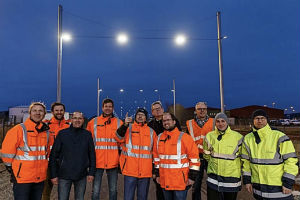
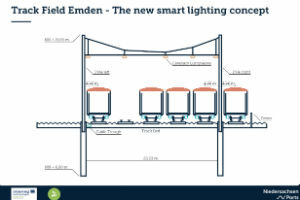
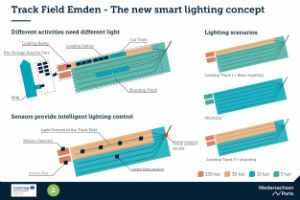
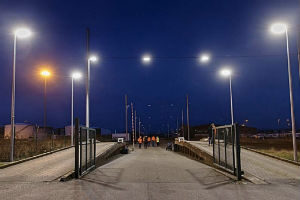 The incandescent light bulb, traditional timer switches, and ON/OFF switches have all seen better days and are all but obsolete. Today’s lighting systems are smart and energy-efficient. That is exactly why Niedersachsen Ports has implemented an innovative lighting concept at the rail track area in the Port of Emden over the past months. Within the port, this track grouping is used to aid in the transshipment of motorized vehicles, for the shunting and switching, staging and parking, the loading and unloading of car carrier trains (Auto Train rail cars). The types of jobs to be performed, as well as the different areas in need of illumination, require individual lighting scenarios.
Smart Controls for Targeted Light Deployment
The smart control unit is the center piece of this new system. Motion sensors and light and track sensors capture the requirements for the individual situation. Remote-controlling the system is achieved through a web connection and provides light, wherever and whenever needed, and at the exactly required light intensity. When the tracks are idle, for instance, a medium illumination of five lux (~0.5 fc) is sufficient for jobs like general and site security. Shunting requires 15 lux (~1.4 fc), while any unloading operation requires an average light intensity of 30 lux (~2.8 fc). “We are structuring and aligning our ports in a modern and sustainable fashion. These goals are synergetic to each other, the lighting system is a great case in point for this” explains Holger Banik, Managing Director of Niedersachsen Ports GmbH & Co. KG and of JadeWeserPort Realisierungs GmbH & Co. KG.
Energy Efficiency and Climate Protection
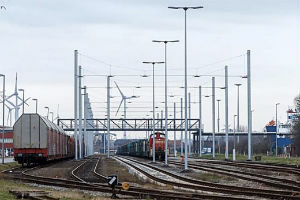 The lighting system is fitted with LED technology, resulting in lower operating and maintenance costs and an overall longer life of the lamps. The lower electricity consumption reduces the CO2 footprint of the port.
Holger Banik is convinced of the benefits: “The energy-saving LED technology, combined with the smart control system, provides a safer work environment in the rail track area. At the same time, we are able to curtail stray light emissions toward the surroundings”.
By mounting two LED lamps to guy wires between two masts each, we were able to ideally illuminate the alleyways between the trains. Since the inception of construction in the summer of 2018, a total of 14 lighting gantries and 11 single masts have been installed. After the masts were erected, the cabling was installed in the trusses and the system was programmed.
The track field illumination was implemented within the realm of the EU-INTERREG project DUAL Ports. The project DUAL Ports aims to collaborate with North Sea ports to create measures and strategies that make the ports more innovative and sustainable. An almost identical lighting project is being implemented at the Danish Port of Vordingborg, and the lighting project has entailed a new pilot project, that will explore the possibilities for smart security – lighting that will connect to port security systems, shedding light on unauthorized activities and adapting lights to different conditions in port operations. You can read more about the SMART SECURITY pilot here.
On the 21stof February, the DUAL Ports project hosted a Hydrogen workshop at the Andromeda Hotel in Oostende.
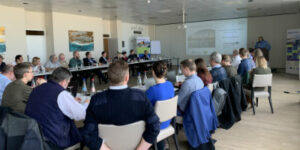 The waters were calm, and the view was fantastic when the Port of Oostende and DUAL Ports bid welcome for a day with a focus on the challenges and opportunities for hydrogen.
The workshop was a part of the DUAL Ports extension kickoff, where many of the new pilot-projects aim to implement the use of hydrogen in different aspects.
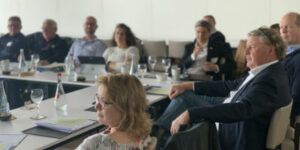
The day started off with a presentation from different international companies, that work in the maritime and shipping industry, or in the field of hydrogen. The question at hand was, is there room for hydrogen in the future of ports and shipping?
 There was no doubt that hydrogen as an alternative fuel has many benefits. Made from renewable energy, hydrogen will be a zero emissions fuel, and will improve the global environmental issues, but also improve local carbon and noise pollution – benefitting the local community.
Hydrogen is already being used in different parts of port operations; for transportation of goods by rail with a hydrogen battery hybrid in North America, and for vehicular transportation in the Orkney Islands. Also, Kristina Juelsgaard from Ballard Power presented a reach stacker, that will come into operation in Valencia later this year, driven on hydrogen fuel cells. These are all examples of small-scale use of hydrogen as an alternative fuel.
 The main challenge of implementing hydrogen as a fuel on a large scale in the maritime and shipping industry is the obstacles of regulatory frameworks that are not adapted to the potential risks of hydrogen. There is simply a lack of specific rules concerning hydrogen, which create issues for storage and bunkering. Also, public opinion and customer perception is crucial to the progress. Charles Purkess from ITM Power argued that one of the aims of a large cooperation with Shell is to pioneer hydrogen as a mainstream fuel – the existence of hydrogen at the refueling station will increase awareness with customers, viewing hydrogen as a common alternative fuel.
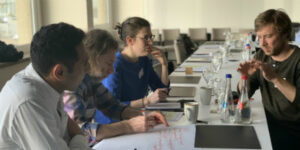 At the end of the day the participants also took part in group discussions about the technical, management- and business-related issues for implementing hydrogen. The primary conclusions of the workshop were that the optimal conditions for the implementation of hydrogen in shipping and maritime operations will be the access to renewable sources for the production of hydrogen, advances in storage and bunkering facilities, and a large-scale demand will be a necessity for development – the crucial element is regulatory frameworks that adapt to hydrogen. Maria Brandsøy from the Maritime Business Association Flora in Norway described an electric revolution in Norway, which derived from the Norwegian Parliament’s decision made in 2015, that all ferries and new tenders had to be low or zero emission. As she argued, the same revolution could be possible for hydrogen.
You can see the presentations from the workshop here.
Maria Brandsøy, Maritime Business Association Flora, Norway – Ocean Hyway Cluster
Jonas Brendelberger, Zepp Solutions, Netherlands – Hydrogen development in shipping – scaling up
Charles Purkess, ITM Power, UK – Practical experiences with hydrogen in operation – land and sea
Extension approved for DUAL Ports
On the 11thof December 2018, the Steering Committee of the Interreg VB North Sea Region Programme has approved the extension of the DUAL Ports project. This entails that the DUAL Ports project has welcomed six new partners and will be implementing eight new pilot-projects.
6 additional partners from the public and private sector and academia will bring new expertise and experience to the DUAL Ports project. With different backgrounds and different skills, the new partners will bring additional competencies to the project and investigate further into sustainable technologies.
So far, the DUAL Ports project has been able to demonstrate eco-innovative solutions that can reduce the carbon footprint of ports in the North Sea Region and, at the same time, be economically viable. As an example, the LED Pilot realised at the Port of Emden, Germany, has shown a 3% reduction in total costs, but more importantly a staggering 80% carbon emission reduction, compared to conventional lighting.
The SOIL Pilot realised at the Port of Vordingborg, Denmark, has shown a 4% carbon emission reduction and a 10% total investment cost reduction, compared to a ‘non-green’ soil treatment.
These promising results have arisen the interest of external organisations, willing to join the project to test other technologies that, if integrated to the existing ones, could allow ports to be much more sustainable and utilize in some cases even 100% renewable energy sources.
The new pilots in the DUAL Ports extension are all pilots that improve, complement and inter-link with the already existing pilots. The new solutions introduced in the project are motivated by a clear market need to develop new pragmatic and cost-effective technologies, that support ports in their ambition to become more sustainable.
With the addition of 8 new pilots the spectrum of potential environmentally friendly solutions applicable to small and medium sized ports will be broadened and their results evaluated, in order to propose varied alternatives to harbour authorities in the North Sea Region and enable them to make informed decisions on which investments to pursue, considering both environmental and economic argumentations.
The new pilots are deemed to increase the carbon reduction from 10% to 12%, given the fact that some of them are based on the integration of fully renewable energy sources, such as wind, sea, solar and hydrogen. Not only the ports involved, but also the relevant towns will benefit from the cleaner environment, by reducing the public healthcare costs; a reduction that has already been calculated for the foreseen investment at the Port of Skagen, Denmark.
On the 21stof February the DUAL Ports project will host a kick-off meeting for the extension of DUAL Ports. The kick-off will be the first partnership meeting where the new partners will be introduced. Also, a workshop on the possibilities of the use of hydrogen will be conducted.
The new partners are:
- Port of Hvide Sande, Denmark
- Hvide Sande Fjernvarme A.m.b.A, Denmark
- Laminaria BVBA, Belgium
- Uppsala University, Sweden
- Seabased AB, Sweden
- Celtic Cruises LTD, United Kingdom
The new pilots are:
- HEAT– using renewable rest-energy to supply heating
- SEA POWER– demonstrating the potential of wave energy
- WAVE– supplying clean power and using surplus energy
- SEDIMENTS– developing a sustainable concept for removing pollutants
- SAIL CARGO TEST– testing innovative, sustainable cargo transport by sail
- SURFACE– testing new technologies to absorb and reduce emissions
- SMART SECURITY– testing an LED smart signalization system for port operations
- CAPACITY BUILDING PROGRAMME– expanding port staff’s know-how on low carbon solutions and technologies piloted through DUAL Ports
At the inner port of Oostende, the DOCKLAND FINE CHEMICALS pilot is trying to develop a business scheme for small chemical companies, focusing on cost and energy efficiency. For small companies in chemical and gas industries (SEVESO-bound), the number of permits, security measures and safety regulations is overwhelming, hindering the business from developing in a sustainable way.
The idea
The idea behind the DOCKLAND pilot was initiated by GFS, an independent company, specialized in the storage and the handling of liquified gases, located at the Port of Oostende. For companies with high risk products, such as gas storage, chemical components or otherwise, governments and local legislators demand a high level of permanent control and reporting in order to guarantee the safety of the handling and the storage. Permits must be applied for and approved, in order to secure the safety of the surrounding environment, and neighboring facilities, both urban or industrial. Struggling with the enormous administrative burden of all these procedures in order to make the site operational, GFS has come up with the idea of developing the concept of co-siting within the chemical industry: by working collectively, small local businesses can save both costs and energy.
The challenge
Every time a chemical production or storage plant wants to change or to expand its operations, it must provide a new risk assessment, in order to prove that the company is not causing any risk to the direct environment. Insofar the new activity is not situated within the borders of the existing permits, this company must apply for permits, securing that the external risks are minimized and that the surrounding environment is safe. It is the company’s responsible to assure and to attest that the procedures and the products are not harming the environment. All these procedures are very time-consuming and very expensive due to the fact that they are hardly coordinated between the different levels of governance.
Moreover, urban planning moves closer and closer to industrial areas, and the ‘not-in-my-backyard’-syndrome, supported by political incompetence, makes it very difficult for small businesses to keep their business operations in a sustainable way. Often procedures are suspended by court decisions, so that relevant investments need to be cancelled, which can hurt the development of the company. Finally, the European Commission has made the regulations much stricter which implies that procedures become even more complicated.
Therefore, the DOCKLAND FINE CHEMICALS pilot aims to offer co-siting to different companies, active in the sector of fine chemicals, giving them the opportunity to share permits and procedures, share facilities, share energy sources and share logistic operations, thereby also saving energy. The overall management of the DOCKLAND concept will manage one major site, whereby 1 overall permit and 1 overall safety procedure, whereafter several SME’s can be clustered and connected (o.a. heath exchange). Permits will be given to the DOCKLAND operator, who takes care of the follow-up of the permit, the implementation of the different controls, the ever changing legislation and the development of the potential synergies. The companies, that sign up to DOCKLAND, will pay rent. The financial means, the human resources and the energy resources, that have been saved in this way, will be re-invested in innovation and development. DOCKLAND FINE CHEMICALS will thus enhance a greener port strategy.
Development so far
One of the challenges of DOCKLAND has been to convince policy makers of the business case – making it possible to give a permit for one site, that will be shared by different companies. Actually, DOCKLAND FINE CHEMICALS, has the support of the Flemish ministries for economic development and for environment. A working group has been set up in order to accompany the difficult administrative processes that need to be coordinated. At the port of Oostende, GFS has started with the preparation of the procedure for the environmental permit, including a risk assessment. And at the Dutch-Belgian port of Gent, GFS has signed up for an area in the port of 13 hectares for organizing the DOCKLAND co-siting.
Meanwhile, the port of Oostende has validated the concept, and has been working on developing on a DOCKLAND OFFSHORE SUPPLY, and a DOCKLAND BREXIT.